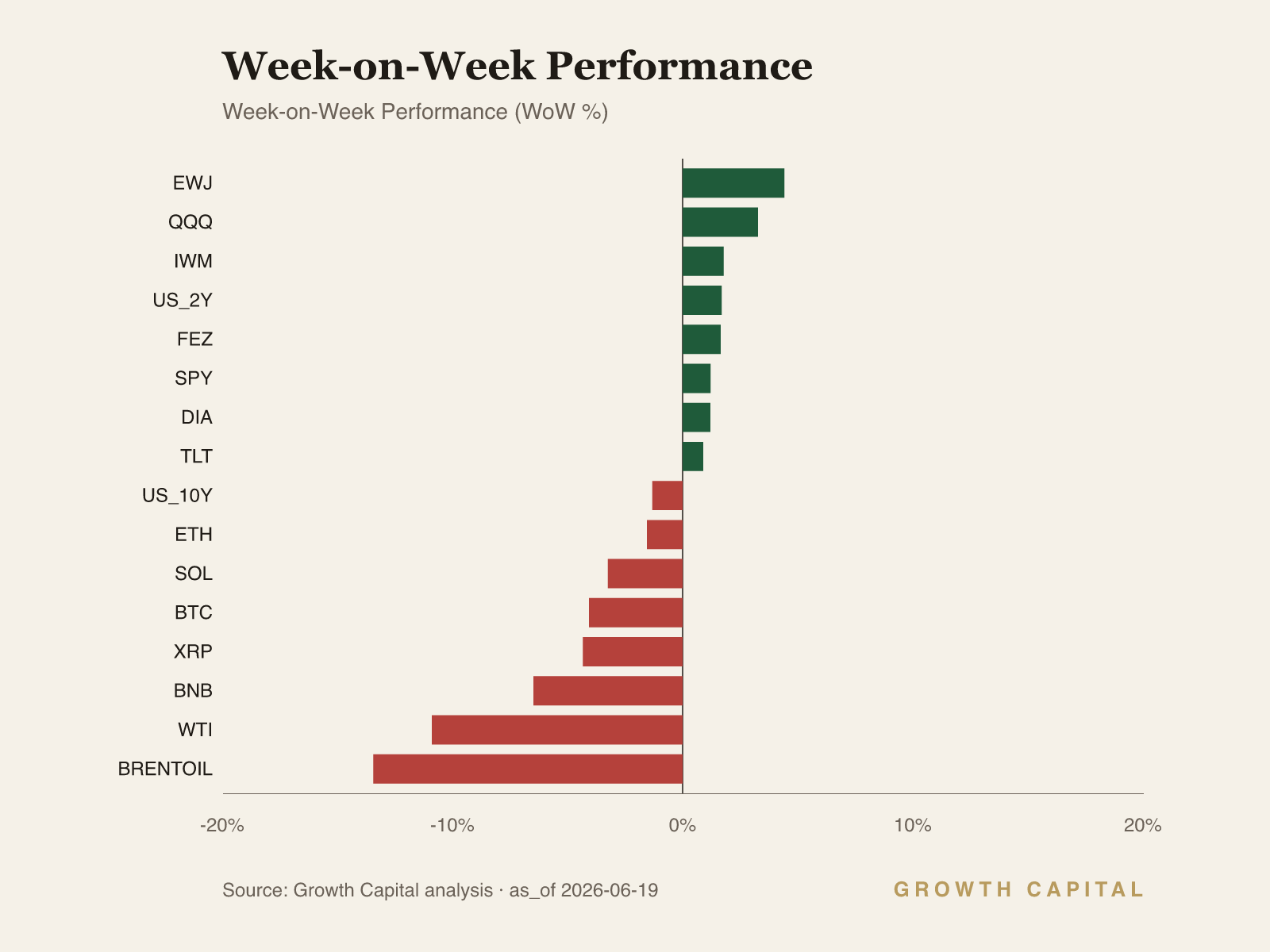
The Fed held at 3.50-3.75% but tilted the dot path higher, and the front end took the message. The 2Y rose to 4.20% (+1.7% WoW) while the 10Y fell to 4.49% (-1.3% WoW), compressing the 10Y-2Y to 27bp.
Crude corrected hard on a US-Iran de-escalation read, and the equity tape disagreed with the rate fear. Brent settled near $84.36 and the S&P 500 proxy SPY closed +1.2% WoW at 746.74, with QQQ +3.3% WoW carrying the index.
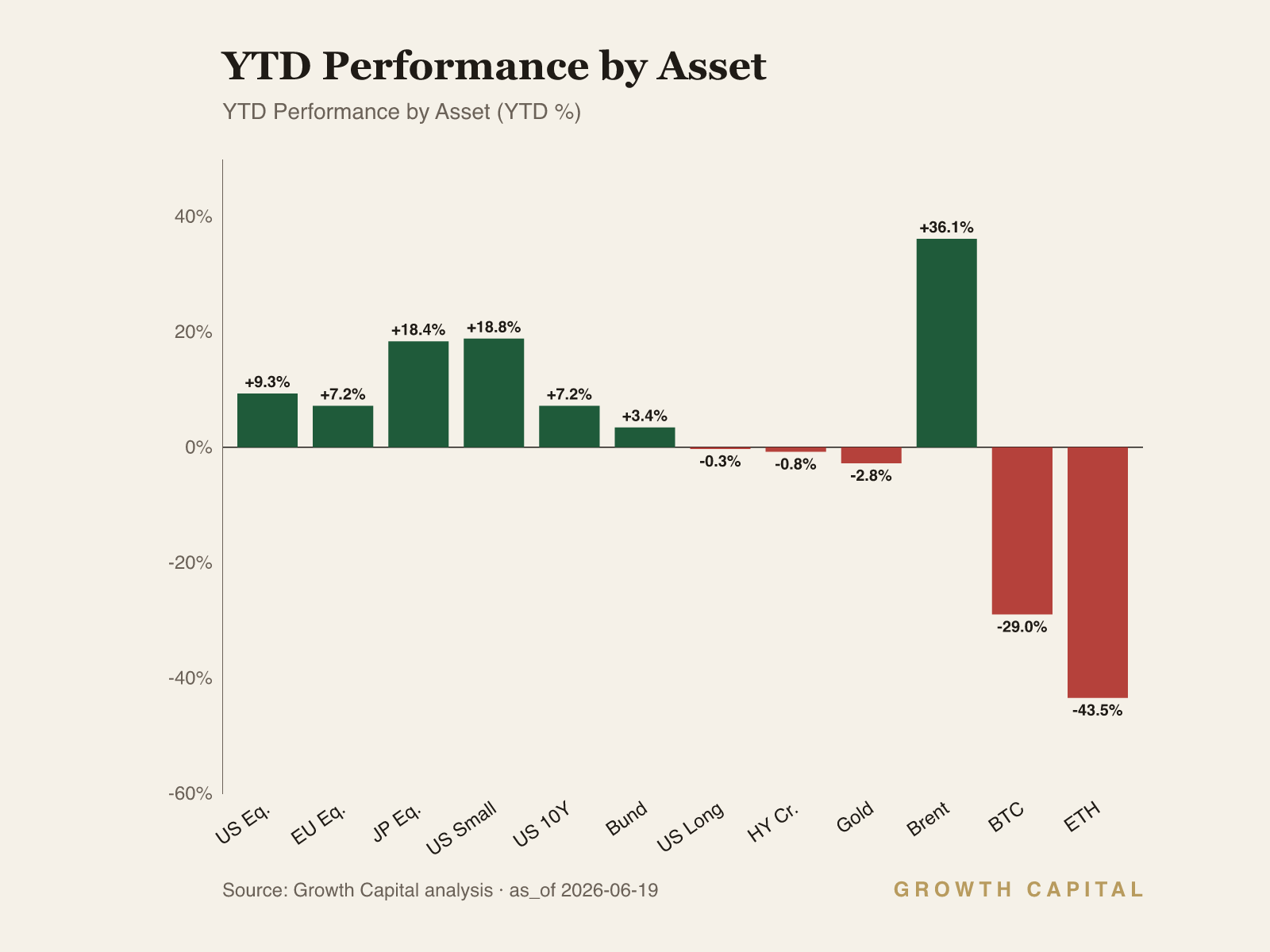
Digital assets remain the cleanest expression of liquidity withdrawal. BTC fell to $63,040 (-4.1% WoW, -29.0% YTD) and smart-trader perps positioning on Hyperliquid runs net short $59.7M.
Our positioning: A hawkish hold has flattened the curve to 27bp while crude unwinds its war premium; we are overweight duration and neutral equity beta.
A hawkish hold flattens the curve while crude unwinds the war premium
We read this week as a hawkish hold layered onto a commodity de-risking, and the two forces resolve into a flatter curve rather than a directional rates break. The FOMC kept the funds target at 3.50-3.75% on 17 June while guiding its projection path higher, and the market repriced the short end accordingly: the 2Y closed at 4.20%, up 1.7% WoW and sitting at its 52-week high, while the 10Y fell to 4.49%, down 1.3% WoW. The 10Y-2Y spread at 4.49% versus 4.20% leaves a 29bp gap on snapshot levels, consistent with the 27bp curve reading from 18 June. Brent at $84.36 fell 13.4% WoW even as it holds +36.1% YTD, and gold via GLD at $387.12 barely moved (+0.2% WoW) against a dollar that eased 0.5% WoW to 119.51 on the broad index. The combination is a policy-led flattening with a simultaneous unwind of the energy risk premium. We frame this as late-cycle: real-rate discipline at the front end, supply-shock relief in commodities, and an equity tape that is still paying for growth optimism rather than pricing the higher-for-longer path.
The primary chain runs through the front end. The 2Y at 4.20%, up 1.7% WoW and pinned at the 52-week high of 4.20%, tells us the market has absorbed the higher dot path and removed the residual cut expectations that lived in the curve a quarter ago. The transmission from here is mechanical: a higher anchored policy rate raises the discount rate applied to the front of every cash-flow stream, which compresses the present value of near-dated coupons and pulls 2Y prices down even as the 10Y rallies on growth and term-premium relief. The long end at 4.49%, down 1.3% WoW and well off the 52-week high of 4.67%, is doing the opposite work: it is discounting the crude correction and a softer inflation path into 2027, so duration at the long end carries while the belly and front sell off. That bifurcation is why TLT at 86.75 rose 0.9% WoW while the 2Y backed up. We are overweight long-duration Treasuries via TLT over a three-to-six-month horizon, accepting curve-flattening carry against the risk that a re-acceleration in core inflation forces the long end back toward 4.67%. We would invert this call if the 10Y breaks and holds above 4.67%, the 52-week high, which would signal the long end is repricing term premium rather than discounting disinflation, and we would cut duration into that move.
The cross-asset tape contradicts the rate fear, and the contradiction is the week's analytical content. SPY closed at 746.74, up 1.2% WoW and 9.3% YTD, with QQQ doing the heavy lifting at +3.3% WoW and 20.8% YTD; the Russell 2000 proxy IWM added 1.8% WoW to print a fresh 52-week high at 295.59. A higher policy path should compress equity multiples through the discount-rate channel, yet the index advanced, which tells us the move is a growth-and-liquidity expression rather than a rate-sensitive one. The mechanism is positioning plus earnings breadth: small-caps and semis led, the dollar eased 0.5% WoW, and the crude correction (Brent -13.4% WoW) lowers the input-cost path for margin-sensitive sectors, so the equity bid is feeding off falling energy and a softer dollar rather than ignoring the Fed. We resolve the tension in favour of the rate signal over the equity signal: the 2Y at its 52-week high is the harder constraint, and we hold equities at neutral with a quality tilt rather than chasing the QQQ melt-up. We would turn more constructive on beta if the 10Y-2Y steepens back through 50bp, which would signal the front end is no longer the binding constraint and growth can be paid for without multiple risk.
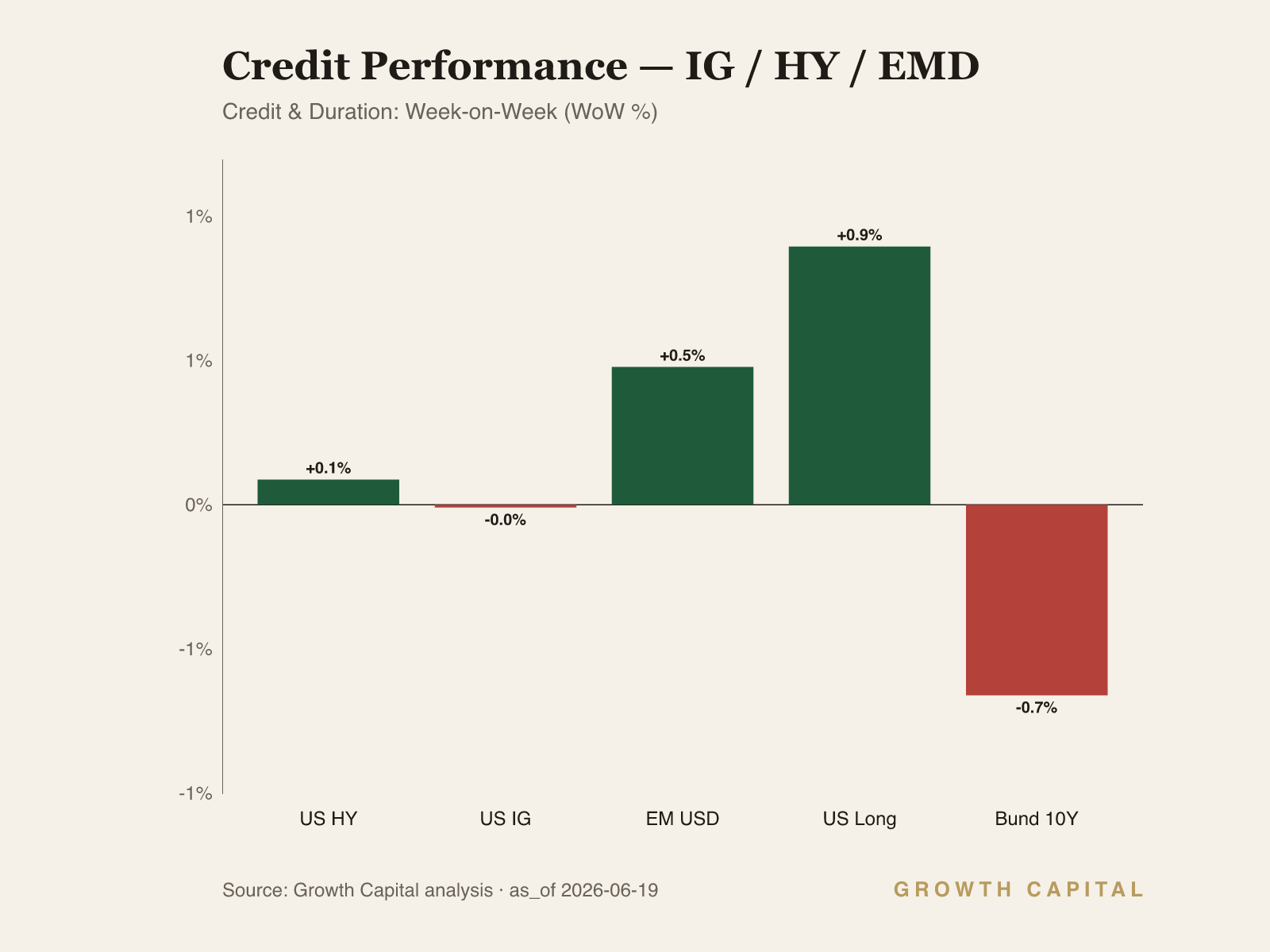
The coherence test sits in credit and FX. IG via LQD was flat (-0.0% WoW) and HY via HYG added 0.1% WoW, with EMB up 0.5% WoW, so spread markets are not corroborating any stress that the curve flattening might imply. EUR/USD at 1.1573 rose 0.3% WoW but remains -1.4% YTD, and USD/JPY at 160.24 sits near its 52-week high of 160.51 after the BoJ moved policy to a multi-decade high, which keeps the carry trade live and the yen the funding currency of choice. The risk-on read in credit is consistent with the equity bid and inconsistent with the front-end repricing, which is the unresolved tension we carry into next week.
What would change our view: a HYG break below its 52-week low of 78.72 would signal the credit channel is finally validating the curve's flattening and we would cut risk across the book. On the upside, a sustained dollar move below the 52-week low of 117.44 on the broad index alongside a 10Y holding under 4.49% would confirm the disinflation-plus-liquidity path and we would add duration and selective beta.
Source: GrowthCapital analysis; data via FRED, Hyperliquid, Nansen.
Fixed Income
The front end is the binding constraint this week, and the curve is the cleanest expression of the hawkish hold. The 2Y closed at 4.20%, up 1.7% WoW and printing its 52-week high of 4.20%, while the 10Y fell to 4.49%, down 1.3% WoW and well off the 52-week high of 4.67%. On snapshot levels that is a 10Y-2Y gap of 29bp (4.49% versus 4.20%), and the official curve read of 27bp on 18 June confirms a near-flat regime. The transmission is direct: the FOMC's higher projection path raises the anchored policy rate, which lifts the discount applied to near-dated cash flows and pulls 2Y prices lower, while the long end discounts the crude correction and a softer 2027 inflation path and rallies. TLT at 86.75 rose 0.9% WoW, consistent with long-duration carry even as the front sells off, though TLT remains -0.3% YTD. The German 10Y at 3.01% fell 0.7% WoW after the ECB's 25bp hike, leaving a wide transatlantic spread (4.49% versus 3.01%) that anchors the dollar's rate advantage. We are overweight long-duration Treasuries via TLT over a three-to-six-month horizon, accepting flattening carry against the risk of a core-inflation re-acceleration. We would cut duration if the 10Y breaks and holds above its 52-week high of 4.67%, which would mark a term-premium repricing rather than a disinflation discount.
Equities
The equity tape advanced into a hawkish hold, and the leadership tells us why. SPY closed at 746.74, up 1.2% WoW and 9.3% YTD, while QQQ outpaced it at +3.3% WoW and 20.8% YTD, and IWM added 1.8% WoW to print a fresh 52-week high at 295.59. The transmission this week is not multiple expansion through lower rates, because the front end backed up; it is a growth-and-input-cost story. The Brent correction of 13.4% WoW lowers the energy cost path for margin-sensitive sectors, the broad dollar eased 0.5% WoW to 119.51, and the combination supports earnings breadth into small-caps and semis rather than a narrow duration-driven mega-cap bid. FEZ at 70.06 rose 1.7% WoW to its 52-week high and EWJ added 4.4% WoW to its own 52-week high at 96.26, with the latter aided by the falling crude path feeding Japanese corporate margins. The risk is that a 2Y pinned at its 52-week high eventually imposes the discount-rate constraint the tape is currently ignoring. We hold equities at neutral with a quality tilt, accepting that we forgo some of the QQQ momentum in exchange for protection against a multiple de-rate if the front end stays elevated. We would move overweight beta if the 10Y-2Y steepens back through 50bp, signalling the front end has stopped being the binding constraint and growth can be paid for without multiple risk.
Commodities
Gold is the cleaner commodity read this week, because the crude complex carries a cross-source divergence we will not lead on. GLD closed at $387.12, up just 0.2% WoW and -2.8% YTD, holding within a wide 52-week range of $300.96 to $495.90. The transmission for gold is the real-rate and dollar channel: a 2Y pinned at its 52-week high of 4.20% raises the opportunity cost of holding a non-yielding asset, which caps gold even as the broad dollar eased 0.5% WoW to 119.51. The two forces roughly offset this week, which is why GLD is effectively flat while the equity and rate tapes moved. Natural gas at $3.06 fell 1.3% WoW and remains in a downtrend, with Permian associated-gas supply growth capping the price path against an 8.5% YTD gain. We hold gold via GLD at neutral over a three-to-six-month horizon, treating it as a real-rate hedge whose carry cost rises with every basis point the front end adds, and accepting that the flat tape offers no edge either way right now. We would turn overweight gold if the 2Y rolls back below 4.00%, which would lower the opportunity-cost drag and let the dollar-weakness channel dominate, or if the broad dollar breaks its 52-week low of 117.44.
Forex
The dollar eased this week even as the front end repriced higher, and the divergence is a positioning unwind rather than a rate signal. The broad dollar index closed at 119.51, down 0.5% WoW and -0.1% YTD, holding mid-range between its 52-week low of 117.44 and high of 121.92. EUR/USD rose 0.3% WoW to 1.1573 but stays -1.4% YTD and slightly oversold, while GBP/USD added 0.4% WoW to 1.3414 after the Bank of England held at 3.75%. The transmission runs through rate differentials and carry: the transatlantic 10Y gap of 4.49% versus 3.01% still favours the dollar, but the ECB's 25bp hike narrowed the policy gap at the front and let the euro recover modestly. USD/JPY at 160.24 was effectively flat WoW and sits just under its 52-week high of 160.51, even after the BoJ lifted its policy rate to a multi-decade high, which keeps the yen the preferred funding leg and the carry trade live. We hold EUR/USD at neutral over a one-to-three-month horizon, accepting that the rate gap caps euro upside while the positioning unwind caps dollar strength. We would turn constructive on the euro if EUR/USD breaks and holds above 1.1980, its 52-week high, which would signal the rate-differential channel has yielded to a broad dollar de-rating.
GC Views
| Asset | View | Rationale |
|---|---|---|
| US_10Y | OW | 10Y at 4.49% (-1.3% WoW) carries duration as the long end discounts the crude correction; flatten via TLT. |
| SPY | N | SPY +1.2% WoW at 746.74 but a 2Y at its 52w high caps multiples; hold quality, do not chase QQQ. |
| GLD | N | GLD +0.2% WoW; real-rate drag from a 4.20% 2Y offsets dollar weakness, leaving no edge. |
| BTC | UW | BTC -4.1% WoW, -29.0% YTD with smart traders net short $59.7M on HL; liquidity withdrawal intact. |
| EURUSD | N | EUR/USD 1.1573 (+0.3% WoW) but -1.4% YTD; the 4.49% vs 3.01% rate gap caps upside. |
| US_2Y | UW | 2Y at 4.20% 52w high after the hawkish hold; front end is the binding constraint. |
| TLT | OW | TLT 86.75 (+0.9% WoW) carries long-duration as the 10Y rallies on disinflation discount. |
| QQQ | N | QQQ +3.3% WoW, 20.8% YTD leads the tape but is exposed to a front-end multiple de-rate. |
| IWM | N | IWM +1.8% WoW at a 52w high on crude relief; rotation strength but rate-constrained. |
| DXY | N | Broad dollar 119.51 (-0.5% WoW) mid-range; rate gap supports, positioning unwind caps. |
| GBPUSD | N | GBP/USD 1.3414 (+0.4% WoW) after BoE hold at 3.75%; range-bound on the rate gap. |
| USDJPY | N | USD/JPY 160.24 near 52w high despite BoJ hike to multi-decade high; carry trade live. |
On-Chain Pulse
The cross-asset on-chain pattern this week is defensive and coherent with the liquidity-withdrawal read in our macro view. Smart traders and public figures run net short across the major derivatives venue, while spot exchange flows show selective accumulation in a handful of names. The lean is risk-off in derivatives positioning even where on-chain flows hint at quiet bottom-fishing, and it lines up with BTC down 4.1% WoW and the broader complex carrying double-digit YTD losses.
Bitcoin is the clearest expression of the defensive lean. Smart traders on Hyperliquid hold a net short of $59.7M, splitting $21.1M long against $80.8M short on total exposure of $101.8M, and public figures echo that with a net short of $17.2M. The largest single perp long is a $2.6M position at 40X leverage carried at an entry near $70,834 and sitting on roughly -$2.8M of unrealised loss, a reminder of how punishing the move to $63,040 has been for late longs. Against the short derivatives posture, on-chain shows a net exchange outflow of -$24.9M and public-figure inflows of +$26.7M, an accumulation signal that contradicts the perp positioning. With BTC -29.0% YTD and trading just above its 52-week low of $60,863, we stay underweight and treat the spot accumulation as a watch item rather than a reversal trigger.
Ethereum carries the most interesting institutional cross-current. The intel block flags a strategic rotation of roughly $17.7M into ETH funded against $230M of BTC sales, which reads as a relative-value reallocation inside the majors rather than fresh net risk-on. ETH at $1,698.01 fell 1.6% WoW and is down 43.5% YTD, the deepest drawdown among the majors we cover, and it sits near its 52-week low of $1,568.69. The exchange-outflow signal in the aggregate report points to quiet accumulation even as derivatives positioning stays defensive. We hold ETH underweight, recognising the rotation flow as a stabiliser but not yet a trend change while the YTD damage is this severe.
XRP shows selective spot demand against a weak tape. The intel block records $20.3M of inflows to XRP amid otherwise collapsed altcoin flows, which marks it as a relative outperformer on the flow side even though price fell 4.3% WoW to 1.134074 and is down 39.6% YTD. The divergence between positive inflow and negative price tells us the inflow is being absorbed by distribution rather than driving a bid, a classic sign that spot demand is not yet sufficient to clear overhead supply. XRP trades just above its 52-week low of 1.092505, leaving little technical cushion. We stay underweight and would need sustained inflow alongside a price reclaim before treating the flow as a signal.
BNB is the weakest major on price and offers no offsetting flow signal worth chasing. BNB fell 6.4% WoW to 575.97, the largest weekly drop in the complex, and is down 33.3% YTD against a 52-week high of 1,305.92. The aggregate report groups BNB with ETH as a name showing net exchange outflows, which is a mild accumulation tell, but there is no smart-trader or whale long of size to corroborate a turn. With the token sitting just above its 52-week low of 571.54 and the broader complex de-risking, the outflow alone does not earn a position. We hold BNB underweight and read the week's move as continued liquidity withdrawal from the higher-beta majors rather than a tradeable dislocation.
Frontier Watch
The frontier signal this week is the SpaceX listing, which closed up 20% on its debut and reset the private-market reference point for the largest deep-tech names. We read the pop as a liquidity-and-narrative event rather than a fundamental re-rating: a successful mega-cap private listing pulls risk appetite toward the frontier even as the public crypto complex de-risks, which is the kind of bifurcation that defines a late-cycle bubble where capital concentrates in the highest-conviction stories. The AI-infrastructure thread reinforces this. Ciena's quarter, with 40% revenue growth, 290% EPS growth, a $600M single-quarter backlog build, and a first hyperscaler multi-rail order, confirms the scale-across thesis that physical AI buildout is still accelerating at the optical layer. The constraint is real on the supply side: full optical inspection of a single photonic integrated circuit for co-packaged optics runs over 100 seconds, a test-equipment bottleneck that caps the pace of CPO module qualification. We frame the frontier as the cleanest expression of the liquidity that is leaving public crypto and concentrating in private deep-tech and AI-infrastructure equity. The risk is that this concentration is itself a late-cycle tell, with shadow-financing structures channelling private credit into AI capacity outside traditional balance-sheet supervision, a transmission channel that can turn procyclical if refinancing pressure builds. We treat the frontier as a thematic overweight for long-horizon allocators with the explicit caveat that the funding structure, not the demand, is the vulnerability.
What We're Watching
The 10Y at 4.49% is the level that governs the duration call: a break and hold above the 52-week high of 4.67% inverts our overweight TLT view and signals the long end is repricing term premium rather than discounting disinflation, and we would cut duration into that move. On credit, HYG at 80.01 breaking below its 52-week low of 78.72 would validate the curve's flattening as genuine stress, and we would cut risk across the book. On the upside, a broad dollar break below 117.44 with the 10Y holding under 4.49% would confirm the disinflation-plus-liquidity path, and we would add duration and selective beta. The 10Y-2Y at 27bp steepening back through 50bp would move us overweight equity beta.
This Week in Charts