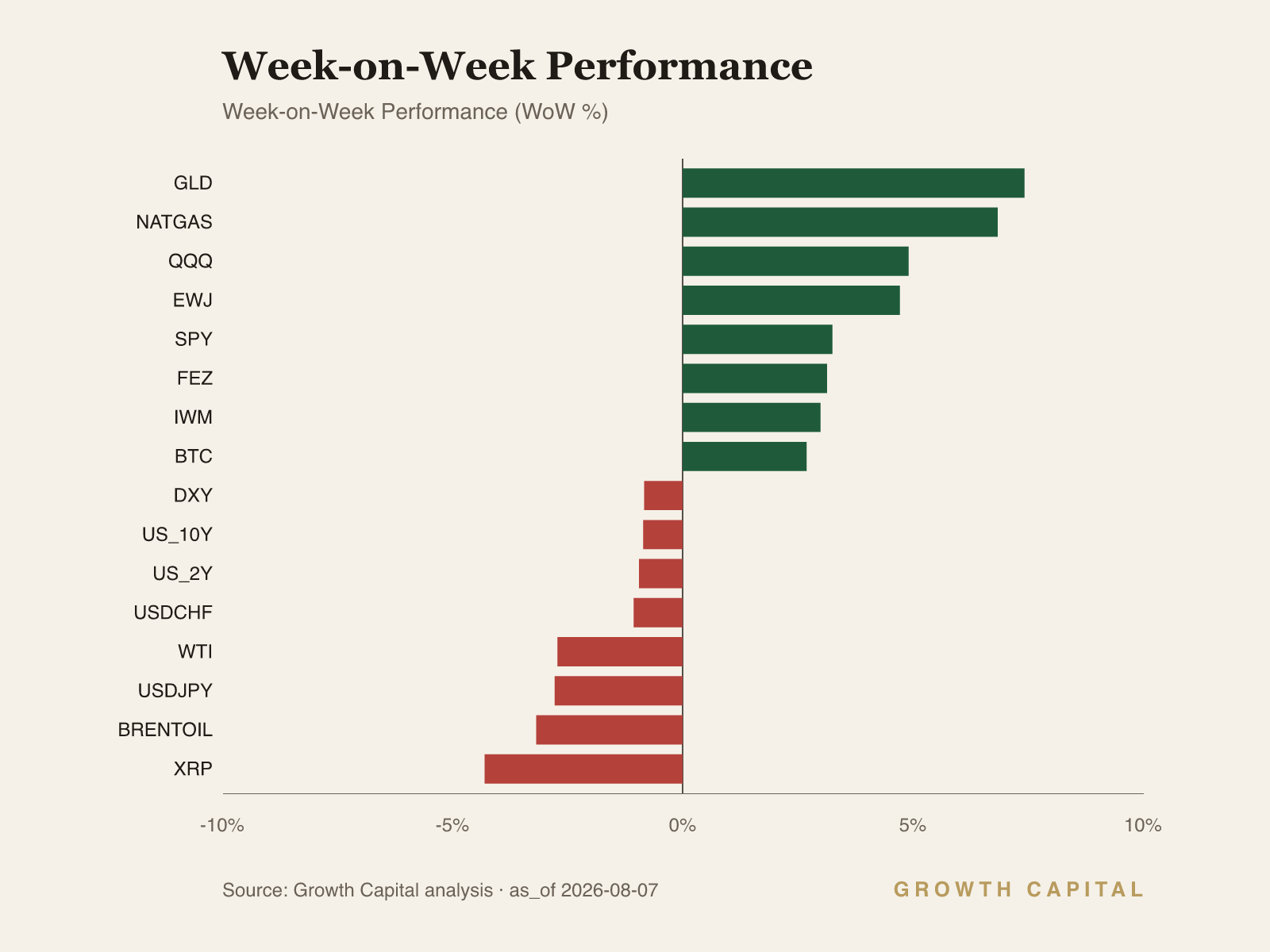
Reported yen intervention has reset the dollar regime. USD/JPY fell -2.8% WoW to 159.16 alongside reports of coordinated US-Japan FX intervention, and the broad dollar index eased -0.8% to 119.70.
Equities bank the easing; credit counts the duration cost. SPY closed at a 52-week high of 771.33, +3.3% WoW, while LQD sits -3.2% YTD with the 10Y at 4.63%, a strict duration ordering rather than credit stress.
Gold's +7.4% week is hedge demand, not risk-off. GLD rallied to 399.13 alongside equity highs and a falling dollar, the signature of allocators insuring against managed-currency failure rather than fleeing risk.
Our positioning: Reported yen intervention has bought a real easing; we underweight the dollar and add duration while the 10Y holds below 4.75%.
Reported yen intervention has loosened financial conditions and set an expiry date on the rally
The week's regime is intervention-underwritten risk-on: the official sector stepped into the currency market, and every major asset class repriced around that fact. USD/JPY fell -2.8% WoW to 159.16 following reports of coordinated US-Japan FX intervention on 31 July. We flag the confirmation gap rather than write around it: our intel carries this as market commentary, not as a US Treasury or Japanese Ministry of Finance release, and one source in the same pool disputes the characterisation. The price action is not in question; the official attribution is, and we size the view accordingly. The broad dollar followed, with DXY -0.8% WoW to 119.70, and the easing in dollar funding passed directly into risk assets. SPY closed at 771.33, +3.3% WoW and a fresh 52-week high, while QQQ added +4.9% and EWJ +4.7%. Treasury yields eased in sympathy, the 10Y at 4.63% against the 2Y at 4.18%, a 45bp positive gap. We treat this as a real loosening of financial conditions, but one with an expiry date: intervention buys time, it does not repeal the fiscal and inflation arithmetic that pushed the 10Y within reach of its 4.75% 52-week high. Our positioning response is to underweight the dollar, add duration, and hold rather than add equity beta at the highs.
The primary driver sits in FX. USD/JPY's -2.8% WoW decline to 159.16 is the largest major-pair move on our screen, and the dollar complex moved in sympathy: DXY -0.8% to 119.70, EUR/USD +1.2% to 1.1519, GBP/USD +0.9% to 1.3470, USD/CHF -1.1% to 0.8081. The transmission runs from the funding currency to global duration. The yen is the cheap leg of the global carry complex; it finances leveraged positions in long-duration assets, including the AI capital-expenditure trade, so a disorderly yen squeeze is a deleveraging event for everything it funds. By backstopping the yen with official purchases, the US and Japan converted a tail-risk squeeze into a managed appreciation, which compresses FX volatility, lets dollar longs unwind in order, and passes through to rates: the 10Y eased -0.9% WoW to 4.63% and the 2Y -0.9% to 4.18% in the same week the dollar fell. We move underweight the dollar on a one-to-three-month horizon, expressed long EUR/USD from 1.1519, and we accept the trade-off that intervention effects decay and that the US front end at a 4.18% 2Y still out-carries G10 alternatives while we wait. This is a tactical stance, not a structural dollar call. A USD/JPY close back above the 163.86 52-week high would invert it; that level would tell us private carry demand overwhelmed the official bid, and a failed intervention re-opens the disorderly-unwind tail we currently price as closed.
Equities confirm the easing read; credit qualifies it. SPY at 771.33 is +3.3% WoW at its 52-week high and +12.9% YTD with breadth behind it (IWM +3.0% WoW, +20.6% YTD), while credit total returns are still negative on the year: LQD -3.2% YTD, HYG -1.3% YTD, TLT -4.9% YTD. The reconciliation is a duration story, not a credit story. The 10Y at 4.63% has risen from a 3.97% 52-week low, and that repricing compounds mechanically through bond duration: the longest-duration instrument on our screen (TLT, -4.9% YTD) has suffered most, intermediate-duration investment grade (LQD, -3.2%) next, and short-duration high yield (HYG, -1.3%) least. That strict ordering by duration rather than by credit quality tells us the discount rate, not default risk, is doing the damage; HYG at 79.62 holds above its 78.72 52-week low with a +0.2% WoW gain, so spreads carry no stress signal. The cross-asset tape therefore confirms the regime with one warning attached: equity multiples are being paid for out of a discount-rate reprieve that intervention bought, not out of a completed disinflation. We hold SPY at neutral given the slightly overbought reading at the high, keep QQQ overweight where the +17.7% YTD trend has room to the 746.16 high, and add duration through TLT at 82.78, slightly oversold near its 82.19 low. A 10Y print through 4.75% breaks this reconciliation; at that level the duration drag resumes, the credit ordering deteriorates from the long end inward, and the equity multiple loses its sponsor.
The second rail is metals. GLD rose +7.4% WoW to 399.13, its strongest week on our screen, yet it remains in a designated downtrend, +0.2% YTD and roughly 19% below its 495.90 52-week high. A gold bid of that size alongside an equity 52-week high and a falling dollar is not risk-off; it is hedge demand. When the official sector actively manages the world's core currency pair, allocators buy insurance against the management failing, and gold is the cleanest expression. Crude corrected as de-escalation signals emerged around Hormuz shipping, but our primary and crosscheck price feeds for the oil complex diverge beyond tolerance this week, so we withhold a numeric read and carry a neutral crude stance until the sources reconcile. The coherence check with the regime passes: dollar down, duration bid, equities up, gold up is the pattern of an intervention-eased tape rather than a growth scare. We hold GLD at neutral; the rebound is real, the trend is not yet ours to own.
What would change our view is specific, and we publish the levels. On the downside, a 10Y close above the 4.75% 52-week high combined with USD/JPY back above 163.86 would mean the intervention failed at both ends; in that scenario we cut the duration overweight, take SPY to underweight, and expect credit damage to spread from TLT inward. A HYG break below its 78.72 52-week low would upgrade the warning from duration drag to spread stress, and it would do so before the equity indices register it. On the upside, a DXY break below its 117.44 52-week low with HYG holding above 78.72 would confirm the easing is running without credit cost, and we would take index equities from neutral to overweight and extend the duration position. In digital assets, a BTC close below its 58,608.4 52-week low validates the smart-trader short book we detail in the on-chain section and takes that sleeve to maximum underweight. Between these markers we run the stance as drafted: underweight dollar, overweight duration, neutral index beta, neutral gold, underweight digital assets.
Source: GrowthCapital analysis; market snapshot as of 7 August 2026; Nansen and Hyperliquid on-chain intelligence; July FOMC and ECB policy statements.
Forex
USD/JPY is the week's thesis. The pair fell -2.8% WoW to 159.16, the largest move on our major-pair screen, after reported coordinated US-Japan FX intervention on 31 July. The mechanism runs through the carry complex: the yen funds leveraged long-duration positions globally, so an uncontrolled yen squeeze forces deleveraging across every asset it finances, while an officially managed appreciation compresses volatility and lets positions unwind in order. The dollar side confirms the transmission: DXY eased -0.8% WoW to 119.70, essentially flat YTD at +0.1%, and EUR/USD rose +1.2% to 1.1519, still -1.9% YTD and roughly 4% below its 1.1980 52-week high. Our positioning is underweight USD/JPY and the broad dollar on a one-to-three-month horizon, with an overweight in EUR/USD as the cleanest expression of an orderly dollar decline. The trade-off is explicit: US front-end carry at a 4.18% 2Y still out-earns G10 alternatives, so the dollar underweight bleeds carry while it waits, and intervention effects decay unless reinforced. Two levels govern the stance. A USD/JPY close above 163.86, the 52-week high, means the private carry bid overwhelmed the official one and we exit; a DXY break below the 117.44 52-week low extends the trade and would pull our equity stance more constructive with it. Between those levels we let the intervention regime work, and we treat every rally in the pair as distribution, not trend change.
Equities
The equity tape is broad, not narrow. SPY closed at 771.33, +3.3% WoW and a 52-week high, +12.9% YTD with a slightly overbought reading; QQQ added +4.9% to 721.77 (+17.7% YTD, in an uptrend, below its 746.16 high); EWJ rose +4.7% to 96.75 (+19.0% YTD); IWM gained +3.0% to 299.92 and leads the complex at +20.6% YTD, within two points of its 301.71 high. The weekly leadership order runs from longest-duration cash flows down: QQQ +4.9%, EWJ +4.7%, SPY +3.3%, IWM +3.0%, which is the pattern a discount-rate reprieve produces when the 10Y eases to 4.63% and the dollar falls -0.8% in the same week. The YTD order inverts, with IWM ahead at +20.6%; that tells us this year's advance has breadth beneath it and is not a mega-cap crowding artifact. One cross-current deserves weight: EWJ's +4.7% week arrived alongside a -2.8% USD/JPY decline, and a stronger yen is a translation drag on exporter earnings, so the Japan proxy is paying up for easing while it absorbs an FX cost. Positioning: neutral SPY at the high (we hold beta, we do not add into a slightly overbought 52-week-high print), overweight QQQ into the room below 746.16, overweight IWM on breadth and rate sensitivity, neutral EWJ on the FX drag. A 10Y close above 4.75% removes the discount-rate sponsor and takes us to trim mode across the sleeve.
Fixed Income
The Treasury complex eased into the intervention week. The 10Y fell -0.9% WoW to 4.63%, still within reach of its 4.75% 52-week high, and the 2Y fell -0.9% to 4.18%; the curve holds a 45bp positive gap between the 10Y at 4.63% and the 2Y at 4.18%. The front end is the anomaly: at 4.18%, the 2Y sits 55bp above the 3.63% effective funds rate, which means the market is paying for a policy path tighter than the one the Fed is signalling under its reduced-guidance communication stance. The transmission we care about runs from yield level through duration into total return, and the year-to-date tape shows it working with mechanical precision: TLT -4.9% YTD at 82.78 (slightly oversold, near its 82.19 low), LQD -3.2% YTD at 106.68, HYG -1.3% YTD at 79.62. That ordering is duration rank, not credit rank; HYG added +0.2% WoW and holds above its 78.72 low, so spreads carry no stress signal. Our view is overweight duration through Treasuries: the 10Y at 4.63% offers 45bp of curve over the 2Y and a 12bp cushion to the 4.75% high, and if the intervention keeps the yen carry unwind orderly, the long end re-rates lower first. We take the duration in TLT and the front end at the 2Y, and we stay neutral IG credit because clean duration beats spread duration at these levels. The falsifier is one print: a 10Y close above 4.75% ends the trade, and we cut rather than average.
Commodities
Gold is the commodity signal this week. GLD rose +7.4% WoW to 399.13, its strongest week on our screen, yet the position within the range tempers the print: +0.2% YTD, a downtrend designation, and a level roughly 19% below the 495.90 52-week high against a 305.27 low. The mechanism is the dollar and real-rate channel: DXY fell -0.8% and the 10Y eased to 4.63% in the same week, both of which lower the opportunity cost of a zero-yield hedge, and the deeper driver is regime insurance. When the official sector intervenes in the world's core currency pair, allocators buy protection against the management failing, and gold absorbs that demand even while equities make highs; a simultaneous equity 52-week high and a +7.4% gold week is a hedging tape, not a risk-off tape. The oil complex corrected as de-escalation signals emerged around Hormuz shipping, but our primary and crosscheck price feeds for crude and natural gas diverge beyond tolerance this week, so we withhold numeric levels and hold a neutral crude stance until the sources reconcile; conviction requires clean pricing. Positioning: neutral GLD. The +7.4% week earns respect but not a trend allocation while the trend designation remains down and the YTD return sits at +0.2%. A DXY reclaim of 121.92 would cap the rebound and confirm the neutral; a sustained dollar slide through 117.44 alongside a second week of gold leadership would move us to overweight.
GC Views
| Asset | View | Rationale |
|---|---|---|
| US_10Y | OW | At 4.63%, 12bp under the 4.75% 52w high; intervention easing favours duration, we add |
| US_2Y | OW | 4.18% sits 55bp above the 3.63% funds rate; the front end pays for a tighter path than delivered |
| TLT | OW | Slightly oversold at 82.78 near the 82.19 low; cleanest expression of the duration add |
| SPY | N | Slightly overbought at the 771.33 52w high after +3.3% WoW; hold beta, add on pullbacks |
| QQQ | OW | +17.7% YTD in an uptrend with room to the 746.16 high; duration relief flows to growth first |
| IWM | OW | +20.6% YTD leads the complex; easing financial conditions favour rate-sensitive small caps |
| EWJ | N | +19.0% YTD, but the -2.8% WoW USD/JPY move is an exporter translation drag at 96.75 |
| USDJPY | UW | Official yen purchases plus a -2.8% WoW break; we position for drift toward 146.36, exit above 163.86 |
| DXY | UW | -0.8% WoW to 119.70 with official sellers active; 117.44 is the path of least resistance |
| EURUSD | OW | +1.2% WoW to 1.1519 with the broad dollar -0.8%; the intervention regime favours euro recovery |
| GLD | N | +7.4% WoW to 399.13 is hedge demand inside a downtrend from 495.90; respect it, do not chase it |
| BTC | UW | Smart-trader perps net short $48.4M against a -26.5% YTD downtrend; rallies are for reducing |
On-Chain Pulse
Cohort positioning splits along the spot-versus-perps axis this week: on-chain wallets are quiet accumulators while the sharpest derivatives cohort leans short. Total crypto market cap stands at $2.31T (+0.7% over 24h) with BTC dominance at 56.44% and $386.6B of 24h volume, a tape drifting rather than trending. Our read is that sophisticated leverage is positioned against the bounce, and we weight that cohort most heavily.
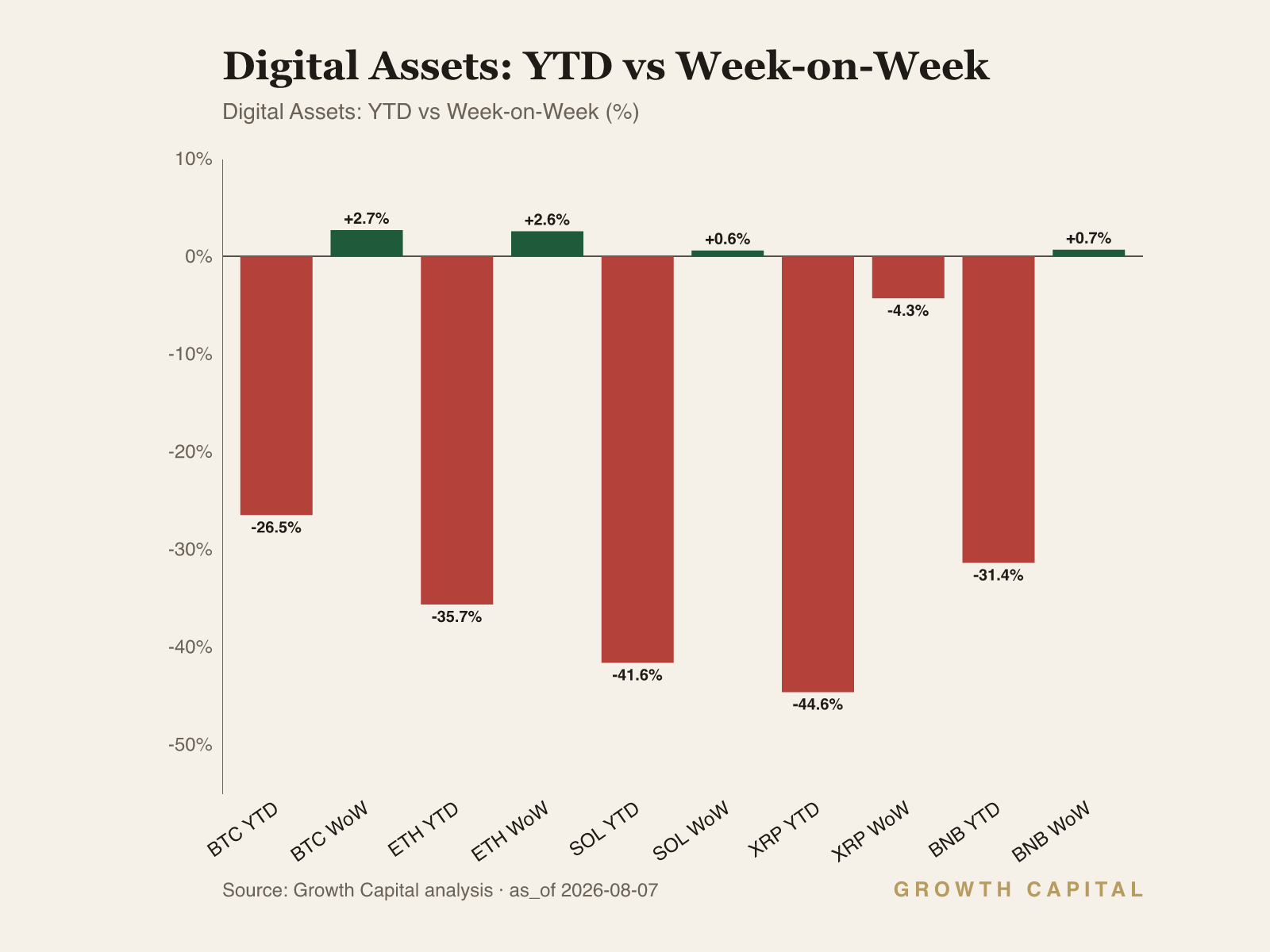
Bitcoin closed the trailing seven days +3.63%, $62,856 to $65,136 on the intel window, against a snapshot that still marks the asset -26.5% YTD in a designated downtrend. On Hyperliquid perps, smart traders are net short $48.4M, $27.3M of longs against $75.7M of shorts, the most bearish smart-money posture across the majors we track. Whales are essentially flat, net short just $370k on a $1.9B book, which means the largest pool of leveraged capital is agnostic while the highest-skill cohort presses the downside; smart-trader gross exposure of roughly $103M is a small fraction of that $1.9B whale book, so the short lean is a conviction signal rather than a flow-dominance signal. The spot side diverges: top-PnL wallets added +$14.8M net (0.9x their average pace), public figures added +$6.4M at 4.8x their average pace, and exchange netflow was a negligible +$1.2M inflow at 0.3x average, with the caveat that our on-chain BTC proxy (WBTC on Ethereum) covers only a thin slice of supply. The open $1.9B Hyperliquid whale book is the best open-interest reference in this week's block. Positioning implication: when quiet spot accumulation meets a determined smart-trader short into a +3.6% week, we side with the leverage until price proves otherwise; we stay underweight BTC and treat strength as an exit, not an entry, with the 58,608.4 52-week low as the downside validation level.
Ethereum gained +3.56% over the window, $1,861.6 to $1,927.9, and remains -35.7% YTD on our snapshot. The on-chain cohort signal is the most constructive in the complex: top-PnL wallets accumulated +$22.2M, the largest smart-money net inflow across the five majors this week. Funds and smart traders added a negligible +$139.9k, 0.1x their average pace, so the institutional cohort is watching rather than committing. This week's intel pull carried no whale perp book, funding rate, or open-interest detail for ETH, and we treat that derivatives read as unavailable rather than infer it from the BTC posture. The result is an asymmetric information state: constructive spot, unconfirmed leverage. Positioning implication: we hold ETH at neutral within an underweight digital sleeve; the +$22.2M top-PnL accumulation earns a watch, not an allocation, until the derivatives cohort confirms it with net-long exposure.
Coverage limits shape the rest of the complex, and we state them plainly. XRP carries no on-chain cohort coverage in our tooling because the XRP Ledger is not indexed, and this week's pull carried no per-asset cohort detail for SOL or BNB, so we omit those three here rather than pad the section with price commentary dressed as flow analysis. At the sleeve level the aggregate picture supports the underweight: dominance at 56.44% says capital inside the asset class keeps consolidating toward BTC, the defensive rotation pattern of a market without fresh marginal buyers, while the smart-trader short book sits against the week's bounce. The falsifiers are clean in both directions. A BTC close below the 58,608.4 52-week low validates the short book and takes the sleeve to maximum underweight; a flip of the $1.9B whale book to a material net long, or a decisive turn in smart-trader positioning from $48.4M short toward flat, would be the first upside signal we would respect. Until one of those prints, the digital sleeve stays underweight and small.
Frontier Watch
Sovereign capital is the frontier signal this week, and it is concentrated in AI infrastructure. The PIF, Silver Lake, and Affinity Partners consortium closed its acquisition of Electronic Arts on 4 August, a statement that sovereign balance sheets intend to hold consumer-technology cash flows outside public markets. Mubadala led Moove's $250M Series C at a $2.1B valuation, co-led by Toyota's Woven Capital, a position on the operating layer for autonomous mobility. QIA participated in SambaNova's $1B Series F alongside General Atlantic, T. Rowe Price, and Capital Group, its second round in the name this year. Bloomberg-sourced reporting also has Mubadala weighing roughly $6.3B for a 500MW AI data centre in Akita, Japan, potentially via consortium. The pattern matters for allocators in two ways. First, the private AI-infrastructure pipeline is being funded by permanent capital that does not mark to market, which supports late-stage valuations even while the listed AI complex digests its leverage; the bid under frontier AI names is structural, not momentum. Second, the Japan data-centre report lands in the same week as the yen intervention: capital that intends to build yen-denominated infrastructure benefits from a managed, stronger-yen entry point, and the two stories reinforce each other. We read the week's flow as a floor under frontier AI valuations rather than a top signal, and we watch whether the EA close triggers follow-on take-privates in adjacent entertainment and platform names.
What We're Watching
Four markers govern the stance. If the 10Y closes above 4.75%, its 52-week high, we cut the duration overweight and take SPY to underweight; that print would mean the intervention reprieve has failed at the long end. If USD/JPY reclaims 163.86, the official bid has been overwhelmed and we exit the dollar underweight. If HYG breaks its 78.72 low, the credit warning upgrades from duration drag to spread stress and equity beta follows it down. On the upside, a DXY break below 117.44 with HYG stable above 78.72 takes index equities from neutral to overweight and extends the duration add. In digital assets, a BTC close below 58,608.4 validates the $48.4M smart-trader short book and moves the sleeve to maximum underweight.
This Week in Charts