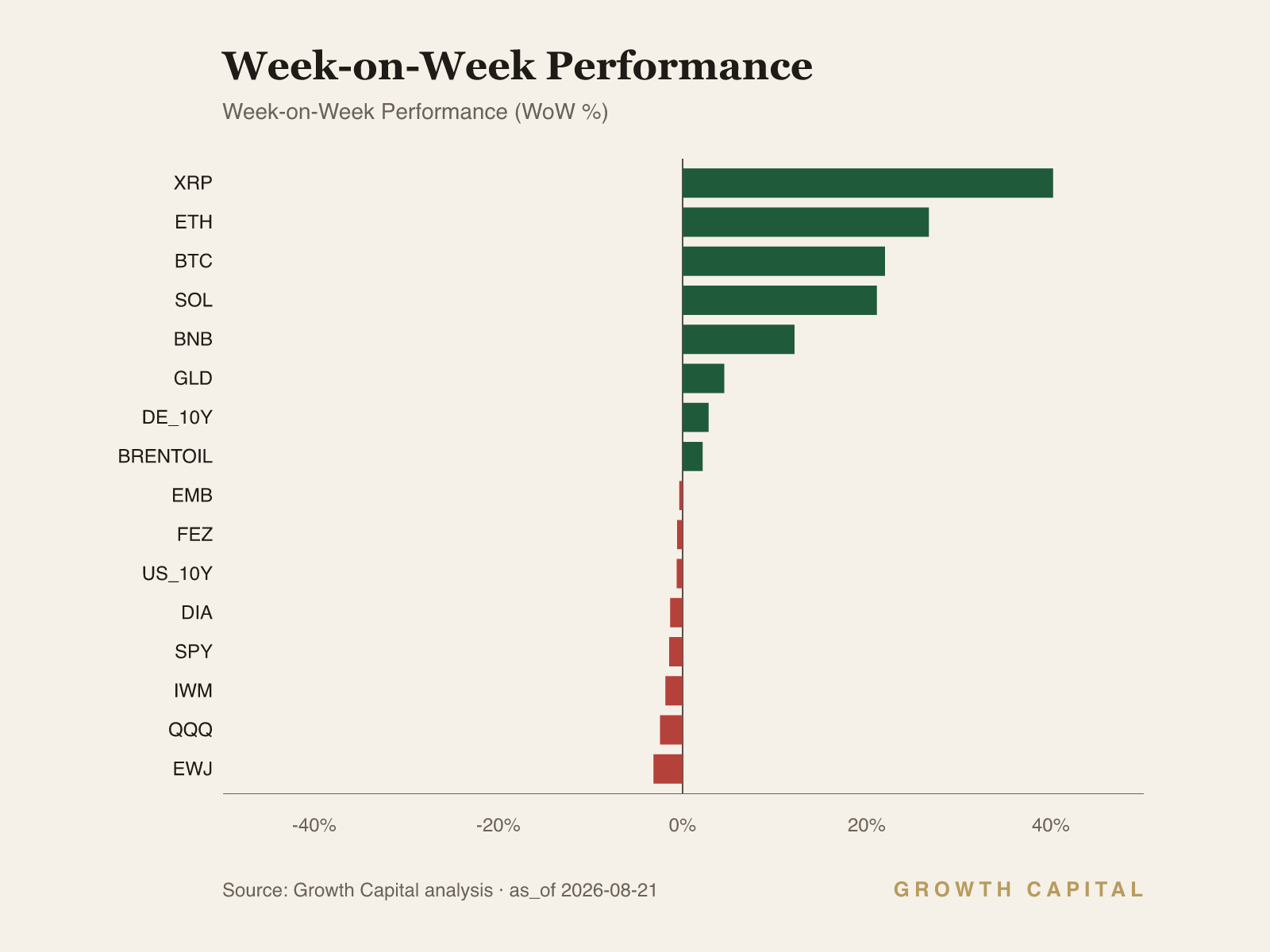
Treasury's upsized long-end buybacks are quasi-curve control. The 10Y closed at 4.65%, 10bp under its 4.75% 52-week high, while gold (GLD) rose +4.5% WoW and Bitcoin +22.0% on the monetization read.
Equities traded the discount rate, not the liquidity. SPY fell -1.5% WoW and QQQ -2.5%, with the longest-duration index underperforming in exactly the order the rates channel predicts.
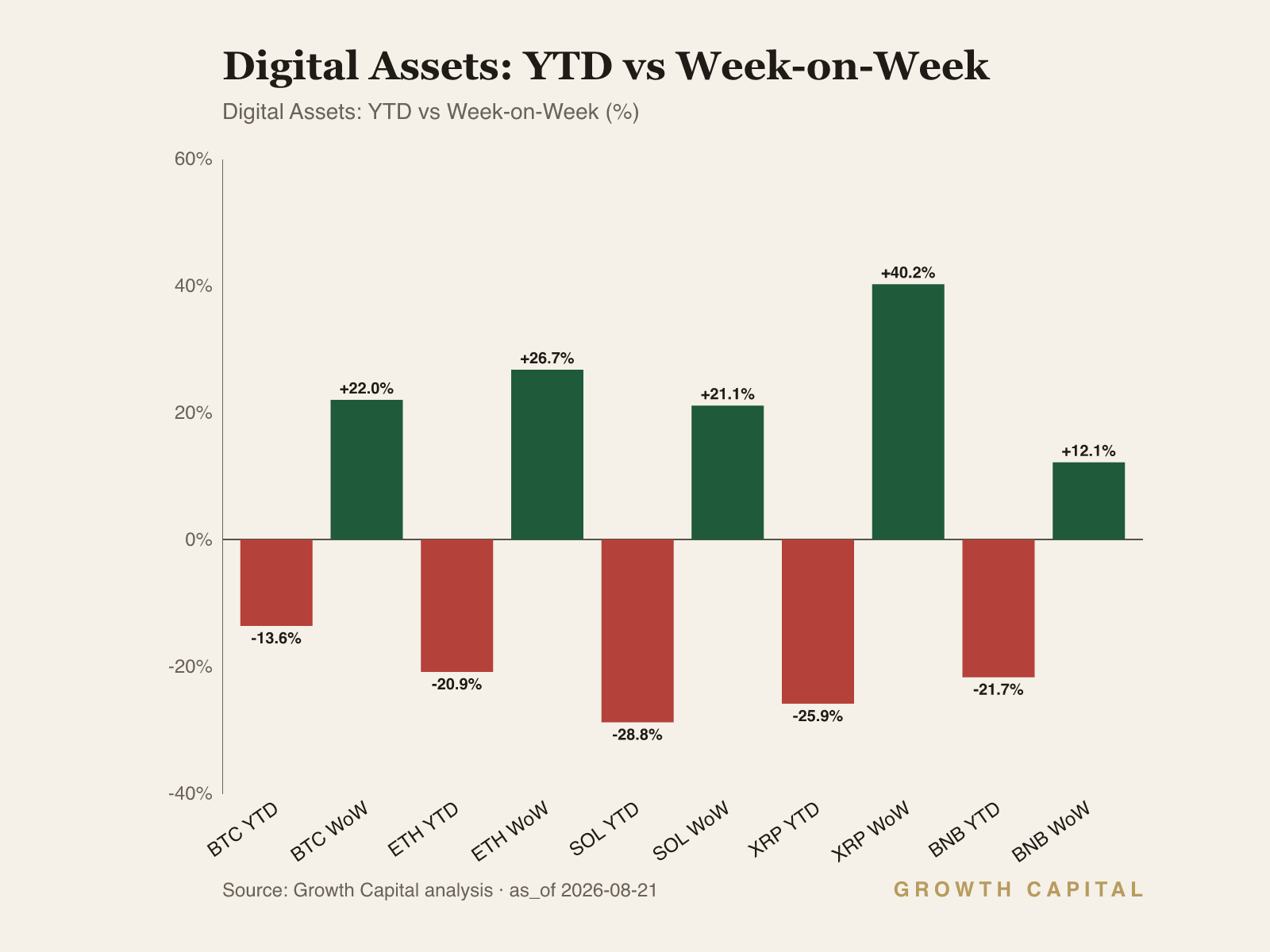
Smart money is fading the crypto rally. Hyperliquid smart traders are net short BTC by $78.7M into a +22.0% weekly move; we stay neutral until that cohort covers.
Our positioning: Treasury's long-end buybacks are soft curve control; we hedge the debasement, trim equity beta, and keep duration neutral.
The Treasury's buyback bid caps yields at the cost of the unit of account
The week's regime is a fiscal-dominance lean. The US Treasury announced upsized nominal long-end liquidity support buybacks beginning 9 September, and every asset class we track repriced around that single decision. The 10Y Treasury closed at 4.65%, holding 10bp below its 4.75% 52-week high even after a supply-heavy tape into midweek. The monetization hedges moved hardest: gold (GLD) gained +4.5% WoW to $419.68 and Bitcoin rose +22.0% to $76,699.6, the largest weekly move in our digital-asset universe outside XRP's +40.2%. Equities went the other way, with SPY down -1.5% WoW and QQQ down -2.5% despite the liquidity headline. Our read is that markets have correctly identified a Treasury willing to absorb the duration risk the private sector will no longer warehouse at these levels. That is supportive for the price of long bonds and corrosive for confidence in the unit of account. We position for the second effect rather than the first.
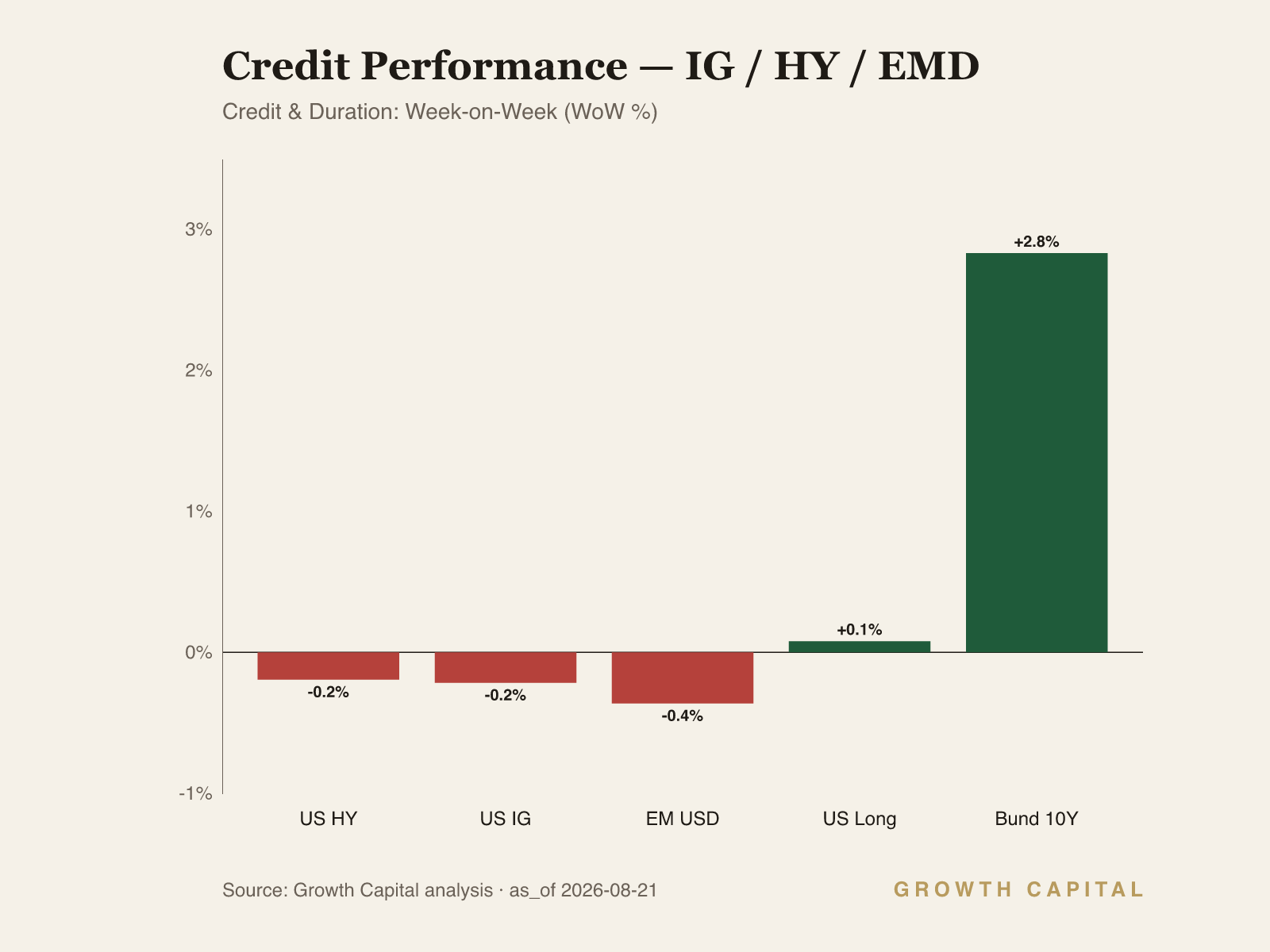
Start with the rates print: the 10Y ended at 4.65%, fractionally lower on the week (-0.6% in yield terms) yet +11.0% YTD and within 10bp of its 4.75% 52-week high, while the 2Y at 4.19% leaves a 46bp positive slope. TLT closed at 82.11, less than a point above its 81.35 52-week low and flagged slightly oversold, and the German Bund at 3.27% (+2.8% WoW) is pressing its own 3.29% high, so the pressure is a global long-end phenomenon rather than a US idiosyncrasy. The transmission runs from issuance to term premium to the unit of account. When the Treasury becomes a scheduled buyer of its own long-end paper, it withdraws duration supply from private balance sheets and compresses term premium mechanically; with the Fed holding its 3.50-3.75% target range since the July meeting, the front end is pinned, so the full effect concentrates beyond the belly. But an issuer buying its own long bonds while running deficits is monetary accommodation by another name, and markets price that through the debasement channel: the marginal hedge against fiscal absorption of duration is not another nominal bond, it is gold at +4.5% WoW and Bitcoin at +22.0%, which is exactly what the snapshot records. We hold duration at neutral on a three-month horizon; the buyback bid truncates the right tail in yields, but a 46bp curve and inflation still above the 2% objective leave no margin for an overweight. The trade-off we accept is forgoing part of any containment rally in TLT from an oversold 82.11. A 10Y close above 4.75% after the 9 September operations begin would tell us the bid is too small against the supply calendar, and we would cut risk further; a decline toward the 3.97% 52-week low on softening prints would signal genuine disinflation and flip us to a duration overweight.
The cross-asset tape looks contradictory at first pass: crypto surged while equities fell, and both call themselves risk assets. SPY lost -1.5% WoW to 765.03, QQQ fell -2.5% to 713.04 and EWJ dropped -3.2%, while total crypto market capitalization rose +7.0% over 24 hours to $2.70T on $380.5B of volume. Credit sided with equities: LQD sits at 105.89, -3.9% YTD, and HYG at 79.56 trades within 1.1% of its 78.72 52-week low. We read this as confirmation of the regime call, not contradiction. The channel is rates to duration to multiples: equity cash flows are long-duration claims discounted off a 4.65% risk-free rate, and the longest-duration index (QQQ, -2.5% WoW) underperformed the shortest (DIA, -1.4%) in precisely the order the discount-rate channel predicts. Crypto and gold did not rally as risk assets this week; they rallied as claims outside the sovereign balance sheet, whose supply no buyback program can expand. We therefore go underweight US equity beta on a one-quarter horizon and pair it with an overweight in gold, accepting the cost of missing a containment relief rally. SPY reclaiming its 777.88 high with HYG back above its 81.32 high would break the compression pattern and force us to rethink the mechanism.
Currency markets carry the second-most-material signal. The yen is the release valve: USD/JPY rose +1.1% WoW to 159.21, in the upper half of its 146.36 to 163.86 range, while the broad dollar barely moved, with DXY at 118.90, -0.1% WoW and -0.6% YTD. Sterling firmed +0.4% to 1.3556 and USD/CHF rose +0.5% to 0.8116, now flagged slightly overbought. The pattern matters for the regime read: if this week were a dollar-confidence event, DXY would be breaking down alongside the Treasury announcement, and it is not. Instead capital is hedging inside the dollar system, out of duration and into scarce assets, while the funding currency with the weakest fiscal arithmetic, the yen, absorbs the pressure. That coherence keeps us neutral EUR/USD at 1.1581 with the ECB on hold at a 2.25% deposit rate against a 3.50-3.75% Fed.
Two falsifiers govern the view. On the downside, a 10Y close above 4.75% combined with HYG breaking its 78.72 52-week low would signal that buybacks have failed to contain term premium and that the stress is migrating into corporate credit; in that scenario we cut equity exposure below the current underweight and extend the gold overweight. On the upside, a 10Y move toward the 2Y's 4.19% with SPY reclaiming 777.88 would indicate disinflation is doing the containment work purchases cannot, and we would restore equity beta to neutral and add duration. In crypto, a cover of the $78.7M Hyperliquid smart-trader net short in BTC would upgrade our neutral stance. We would treat WTI holding above $86.48 into September as a stagflationary complication for both paths, given the +51.2% YTD move already in the price. Absent those triggers, the positioning stands: underweight equity beta, overweight gold, neutral duration and Bitcoin.
Source: GrowthCapital analysis; market data snapshot of 21 Aug 2026; Nansen and Hyperliquid on-chain intelligence; Federal Reserve, ECB and US Treasury releases.
Fixed Income
The long end is the week's decision variable. The 10Y closed at 4.65%, -0.6% WoW in yield terms but +11.0% YTD and within 10bp of the 4.75% 52-week high; the 2Y at 4.19% leaves a 46bp positive slope, and TLT at 82.11 sits less than a point above its 81.35 52-week low with a slight oversold flag. Against that backdrop the Treasury committed to larger nominal long-end liquidity support buybacks from 9 September, a direct intervention in the part of the curve the market is least willing to hold. The mechanism is scheduled duration withdrawal: each operation removes long-end supply from private balance sheets, compresses term premium at the margin, and, with the Fed holding its 3.50-3.75% target range since July, concentrates the effect entirely beyond the belly because the front end cannot move. The intervention is credible enough to cap the tail but not large enough to reverse the trend, which is why the 10Y stalled rather than rallied. We hold duration at neutral on a three-month horizon: the buyback bid removes the worst outcome, while a 46bp curve, inflation still above the 2% objective per the July FOMC statement, and a Bund pressing its 3.29% high argue against reaching for an overweight. The falsifier is explicit on both sides. A 10Y close above 4.75% after operations begin means the bid is undersized and we reduce risk broadly; a decline toward the 3.97% 52-week low on softening data makes TLT the cheap convexity in the book and we extend.
Digital Assets
Digital assets posted the strongest week in the universe, and the composition tells us why. Bitcoin rose +22.0% WoW to $76,699.6, ETH gained +26.7% to $2,377.05, SOL added +21.1% and XRP jumped +40.2%, with total market capitalization up +7.0% over 24 hours to $2.70T on $380.5B of volume and BTC dominance at 57.2%. The timing is the mechanism: the move accelerated on the Treasury buyback announcement, the same catalyst that lifted gold +4.5%, because a sovereign absorbing its own duration pushes the marginal hedging dollar toward assets with fixed supply schedules. The flow channel is visible on-chain, where ETH exchange wallets bled $148.3M of net outflows over seven days while fresh wallets absorbed $594.3M of inflows. Positioning argues for restraint against that flow. Hyperliquid smart traders, the cohort with the strongest realized PnL, are net short BTC by $78.7M on a $270.2M gross book, their most bearish stance across the majors, while ETH top-PnL wallets distributed $25.3M at 2.9x their normal rate. Context matters too: even after this week, BTC is -13.6% YTD and sits far below its $96,897.7 52-week high, ETH is -20.9% YTD and XRP -25.9%, so this is repair inside a drawdown, not a new regime. We hold BTC and ETH at neutral, and we underweight XRP, where a +40.2% weekly move against a downtrend flag and the weakest YTD profile is momentum without cohort support. A covered smart-trader short, with spot flows intact, upgrades the stance.
Equities
Equities traded the discount rate, not the liquidity headline. SPY fell -1.5% WoW to 765.03, still +12.0% YTD but 1.7% below its 777.88 52-week high; QQQ lost -2.5% to 713.04 after a +16.3% YTD run, and EWJ dropped -3.2% to 95.10, the worst of the developed-market proxies, with the yen at 159.21 compounding the move for unhedged holders. The mechanism is the standard one: index cash flows are long-duration claims, a 4.65% 10Y raises the rate at which those flows discount, and the compression lands hardest on the longest-duration growth cohort. The week's ordering confirms the channel, QQQ -2.5% versus SPY -1.5% versus DIA -1.4%, exactly the sequence a term-premium shock produces, and IWM's -1.9% despite a +20.3% YTD lead shows small-cap beta offers no shelter when the risk-free leg moves. Credit does not contradict the read, with HYG at 79.56 trading 1.1% off its 78.72 52-week low. We go underweight US equity beta on a one-quarter horizon, funding the reduction from the largest YTD winners where multiple risk is highest, and we keep EWJ at neutral because the +16.9% YTD equity story is intact and the drag is primarily currency. The trade-off is explicit: if buybacks compress term premium quickly, we lag a relief rally. The trigger to reverse is SPY through 777.88 with HYG above 81.32; that combination would show equities absorbing the fiscal signal without a credit toll.
Commodities
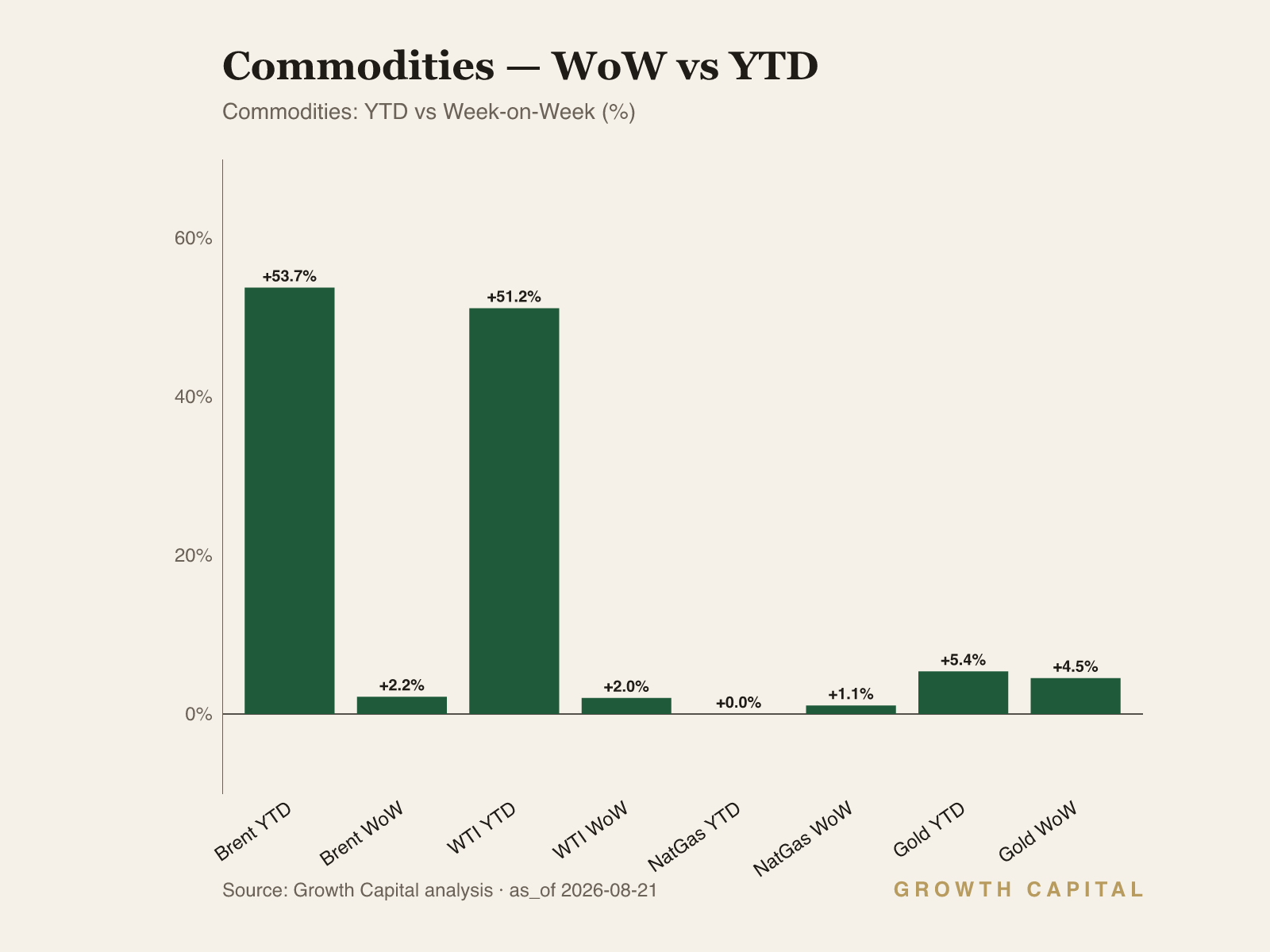
Gold is the cleanest expression of the week's thesis. GLD rose +4.5% WoW to $419.68, the strongest week in the commodity set, and the move came against a down trend flag, which tells us the buyback announcement changed the marginal buyer rather than extended an existing chase. The mechanism is the monetization channel: when the fiscal authority becomes a scheduled buyer of its own long-end debt, the real value of nominal claims carries a policy risk that gold does not, and hedging demand reprices accordingly. Room remains on the chart, with GLD +5.4% YTD in a $307.29 to $495.90 52-week range. Energy runs on a different channel entirely. WTI added +2.0% WoW to $86.48 and is +51.2% YTD on supply disruption and shipping risk through Hormuz, yet the trend flag reads down, and a geopolitical premium of that size is rented, not owned; it exits on any de-escalation headline regardless of what the Treasury does. Henry Hub at $2.82, +1.1% WoW and flat YTD, confirms the energy move is a crude-specific supply story rather than broad reflation. We are overweight gold and neutral WTI: the first hedges the monetization mechanism directly, the second prices an event path we cannot forecast with an edge. Our falsifier is simple on both legs: gold surrendering the full +4.5% weekly gain while the 10Y holds below 4.75% would say the market re-priced the buybacks as technical rather than monetary, and we would cut the overweight; WTI closing back under its 52-week midpoint on a Hormuz resolution would confirm the premium was rented.
GC Views
| Asset | View | Rationale |
|---|---|---|
| US_10Y | N | Buyback bid caps the 4.75% tail but a 46bp curve and sticky inflation block a duration OW; neutral at 4.65%. |
| US_2Y | N | 4.19% fully prices the 3.50-3.75% hold; the +20.7% YTD repricing is done absent a CPI surprise. |
| TLT | N | Slightly oversold at 82.11, under a point off the 81.35 low; buyback support vs supply is unresolved. |
| SPY | UW | -1.5% WoW with a 4.65% discount rate; multiple compression outweighs the +12.0% YTD momentum. |
| QQQ | UW | Longest-duration index fell -2.5% WoW, worst of the majors; most exposed to term-premium risk. |
| EWJ | N | -3.2% WoW is mostly yen at 159.21; the +16.9% YTD equity story is intact, currency drag is the risk. |
| GLD | OW | +4.5% WoW on the buyback signal; monetization hedge with range room toward the $495.90 high. |
| WTI | N | +51.2% YTD is a rented geopolitical premium; the down trend flag argues against chasing +2.0% WoW. |
| BTC | N | +22.0% WoW but Hyperliquid smart traders net short $78.7M; neutral until that cohort covers. |
| ETH | N | $148.3M exchange outflows constructive, but top-PnL wallets distributed $25.3M; neutral, spot skew positive. |
| XRP | UW | +40.2% WoW against a downtrend flag and -25.9% YTD; momentum without cohort support. |
| EURUSD | N | 1.1581 rangebound; ECB hold at a 2.25% deposit rate vs a 3.50-3.75% Fed keeps carry dollar-favoring. |
On-Chain Pulse
Cohort positioning diverges sharply from the spot tape this week: the strongest weekly rally in our digital-asset universe (BTC +22.0%, ETH +26.7%) is being sold, not chased, by the highest-conviction cohorts on Hyperliquid. Smart traders are net short both majors while public figures lean long, and ETH's on-chain spot flows point in a third direction entirely. Granular cohort flows are native for ETH this week; the BTC read comes through Hyperliquid derivatives positioning, and we omit SOL, XRP and BNB where the intel carries no differentiated cohort signal.
Bitcoin's derivatives book is the sharpest single divergence we track this week. Hyperliquid smart traders are net short $78.7M, with $95.8M of longs against $174.4M of shorts on a $270.2M gross book, the most decisively bearish smart-money stance across the five majors. Whales are net long only $12.1M on a roughly $2B two-sided book, split near $1B long and $1B short, so whale gross exposure runs about 7.4x the smart-trader book while carrying essentially no directional lean. Public figures lean the other way, net long $27M ($36.9M long versus $10M short). The spot-versus-perps divergence is stark: spot BTC rallied +22.0% WoW to $76,699.6 while the proven-PnL perp cohort built shorts into strength, and Nansen carries no native cohort spot-flow read for BTC this week, so the derivatives book is the institutional-grade signal. Open-interest concentration sits with the balanced whale book near $2B, which leaves the short $270.2M smart-trader book as the marginal directional voice. Our positioning implication: stay neutral, do not add above $76,699.6, and treat a covered smart-trader short as the upgrade trigger; a forced squeeze through that short is possible, but this cohort's record argues against front-running it.
Ethereum shows three signals pointing in three directions, and the spot leg is the strongest. On-chain over seven days, top-PnL wallets distributed $25.3M of net outflows at 2.9x their average across 187 wallets, smart traders bled a modest $2.4M at only 0.5x average, and whales moved out $938.9k at 6.4x average but across just 8 wallets, too thin a sample to weight heavily. Against that, exchange wallets recorded $148.3M of net outflows, coins leaving venues and reducing available sell-side supply, while fresh wallets absorbed $594.3M of inflows, the clearest new-demand print in the dataset; public figures added $8.7M at 1.3x average across 154 wallets. On Hyperliquid, smart traders are net short a marginal $7.6M on a $111.8M book, whales are net long $11.5M on a roughly $1.8B balanced book, about 16x the smart-trader gross exposure, and public figures hold the strongest long of the group at $42.5M net. The divergence is spot accumulation and exchange drainage against a mildly short high-conviction perp book, all into a +26.7% WoW move that still leaves ETH -20.9% YTD. Our positioning implication: neutral with a constructive spot skew; we would add on evidence the top-PnL distribution ($25.3M at 2.9x) has ended, and we would cut if exchange flows flip to inflows while the smart-trader short widens.
What We're Watching
Three triggers. First, the long end: a 10Y close above 4.75% (the 52-week high) after buyback operations begin on 9 September would mean the bid is failing against supply; we would take equity beta below the current underweight and add to gold. Second, credit: HYG through its 78.72 52-week low would confirm funding stress migrating into corporate balance sheets, and it pairs with the first trigger. Third, crypto positioning: a cover of the $78.7M Hyperliquid smart-trader net short in BTC, or an end to the $25.3M top-PnL ETH distribution, would upgrade our neutral digital-asset stance. On the upside, a 10Y move toward the 2Y's 4.19% with SPY above 777.88 restores equity beta to neutral and adds duration.
This Week in Charts