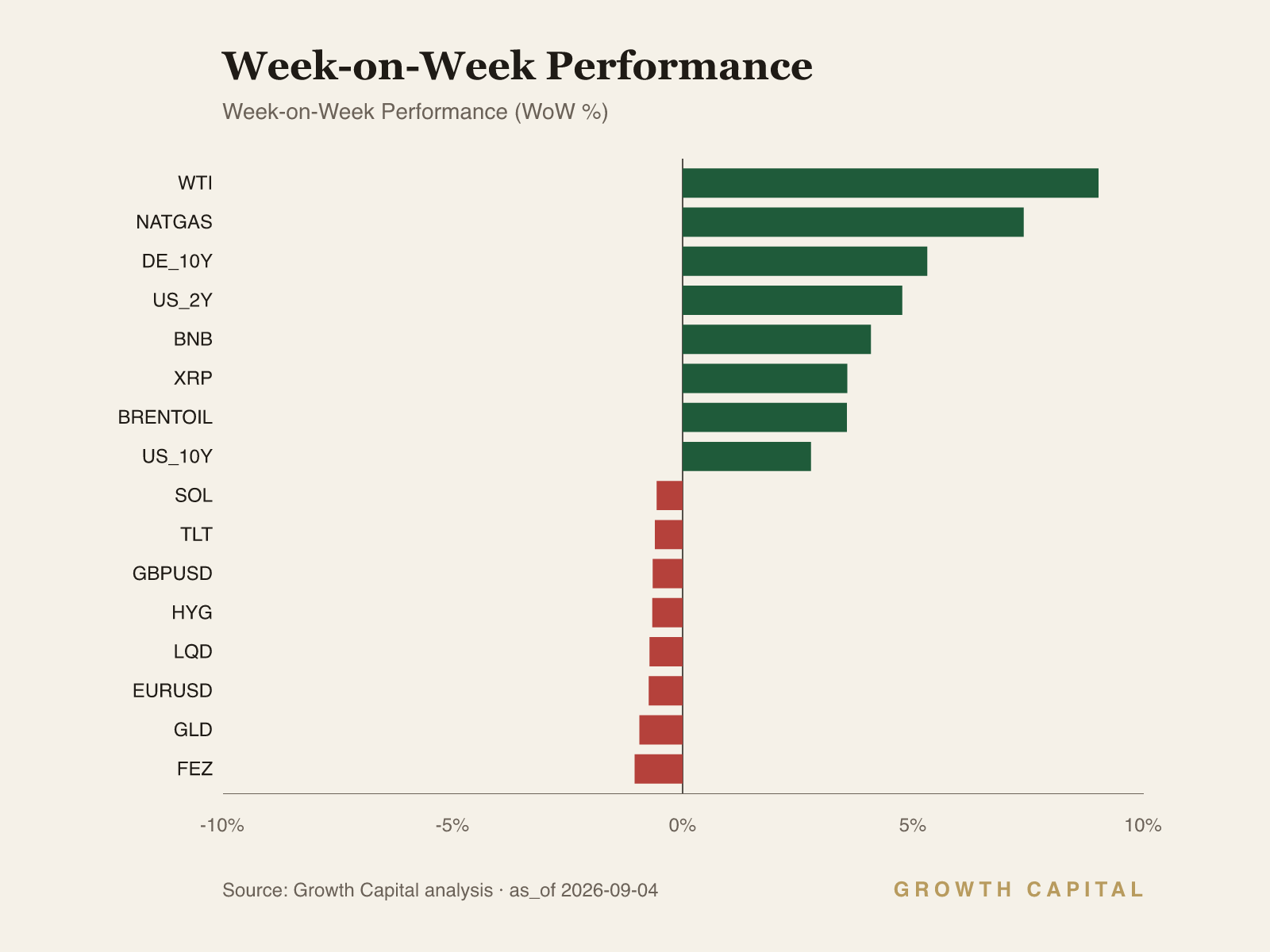
Term premium repriced globally. The US 10Y hit 4.79% and the 2Y 4.39%, both 52-week highs, with the German 10Y up +5.3% WoW to 3.37%.
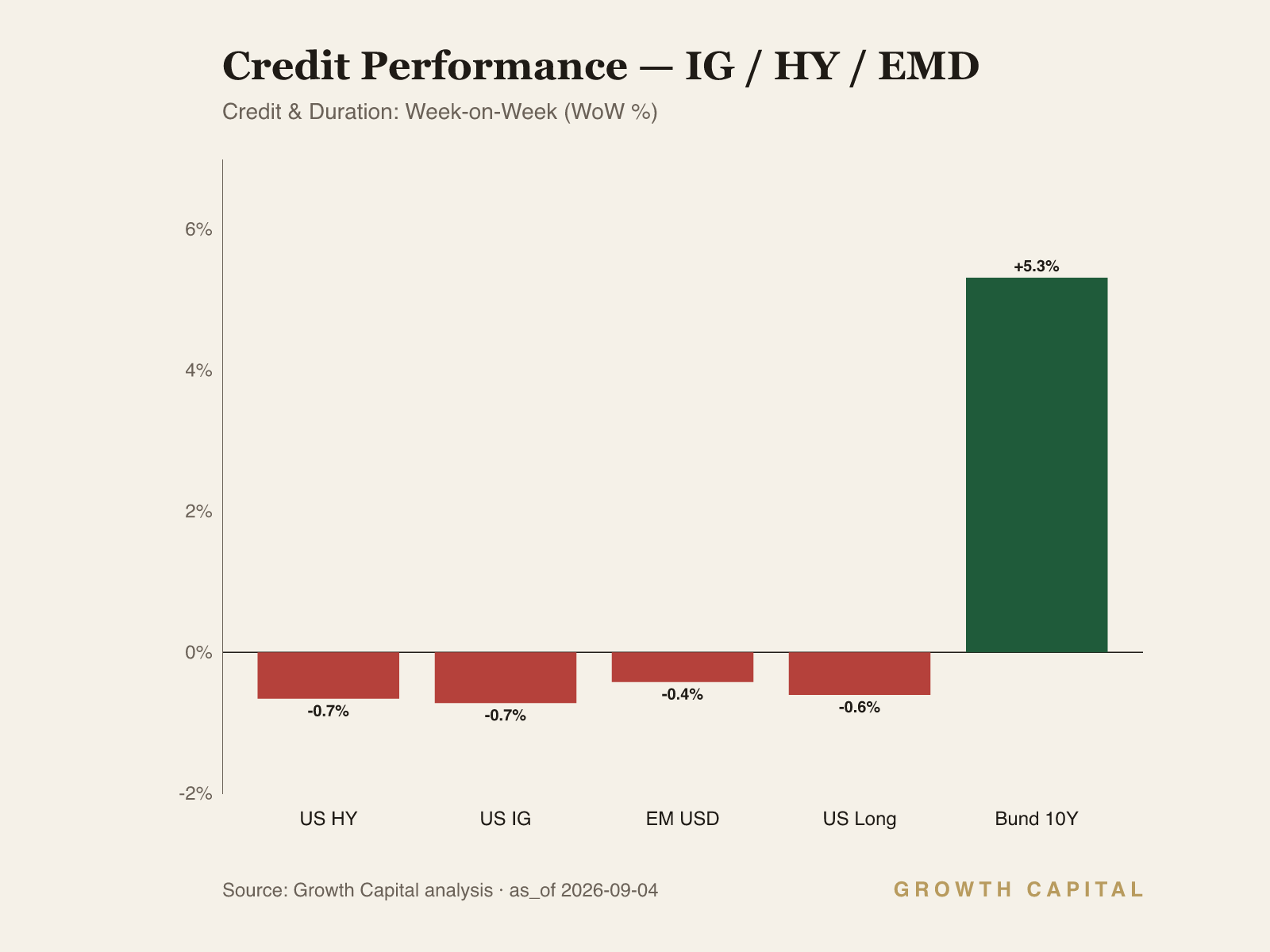
Credit is the honest tape. LQD fell -0.7% WoW to 105.59 against a 52-week low of 105.22, and HYG dropped -0.7% to 79.21 versus a 78.72 floor, while SPY at 772.75 held within 0.7% of its 777.88 high.
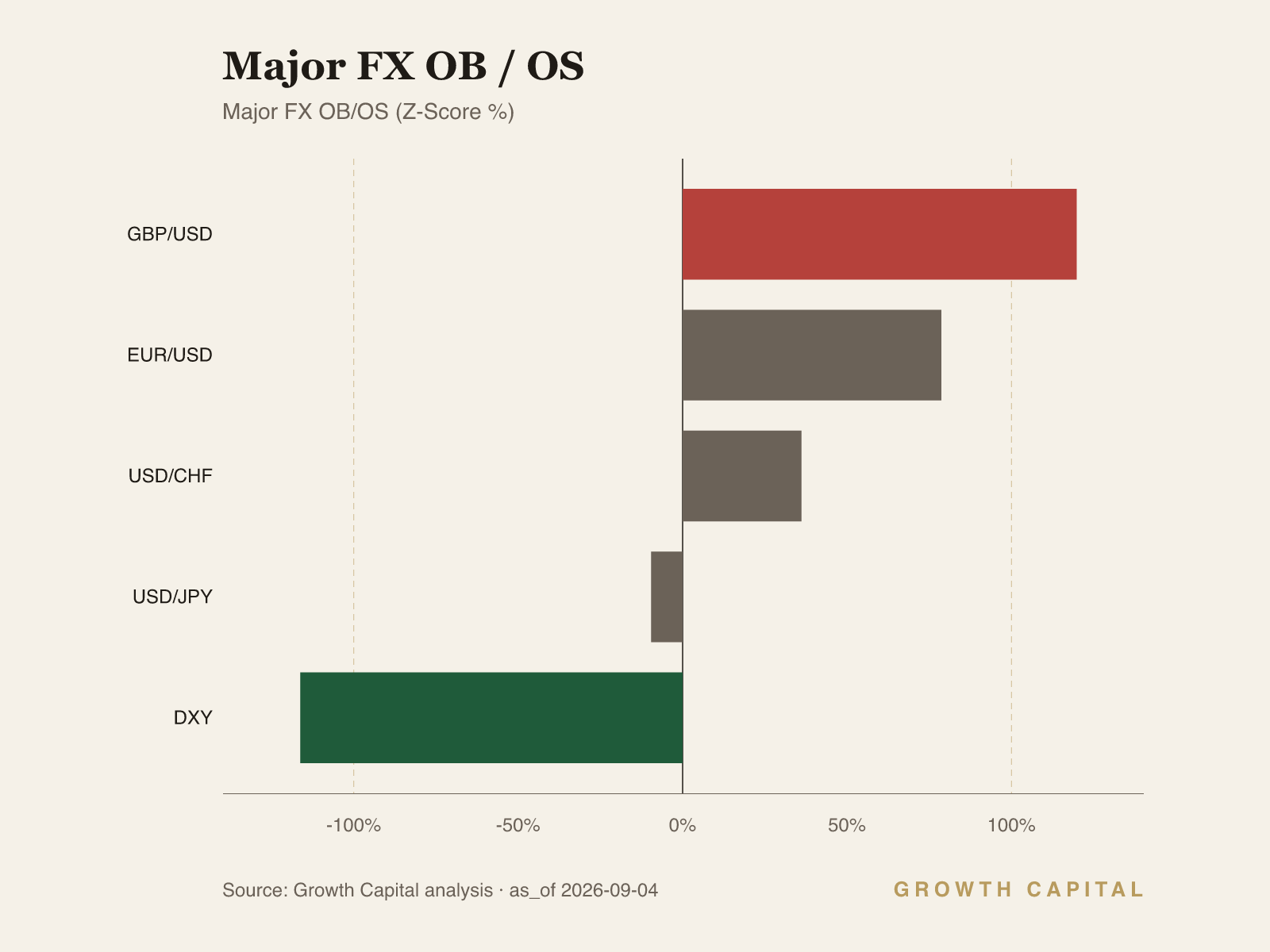
The dollar traded as a yield asset. DXY rose +0.6% WoW to 118.75, EURUSD fell -0.7% to 1.1598, and GLD dropped -0.9% to 405.05 as real rates bit.
Our positioning: Twin 52-week yield highs are a credit event first; we cut IG duration before equity beta reprices.
The term-premium shock routes through credit while equities hold the high ground
The week's regime is a hawkish repricing with a credit warning. Sovereign yields printed 52-week highs on both sides of the Atlantic while equity indices held within 1% of their own highs, and that tension is the house thesis. The US 10Y closed at 4.79% and the 2Y at 4.39%, both cycle highs, a 40bp positive gap. The German 10Y followed to 3.37%, +5.3% WoW, so this is a global term-premium event rather than a US idiosyncrasy. SPY sits at 772.75, +0.4% WoW and 0.7% below its 52-week high of 777.88. Credit dissents: LQD fell -0.7% WoW to 105.59, just above its 52-week low of 105.22, and HYG fell -0.7% to 79.21 against a 78.72 floor. With fed funds at 3.63%, the entire Treasury curve now trades above policy, a structure that prices term premium, not hikes. We read the credit tape, not the equity tape, as the honest transcription of the rates shock.
Start with the observation. The 10Y at 4.79% is not only a 52-week high; the +2.8% WoW rise in yield came alongside a +4.8% WoW move in the 2Y to 4.39%, so the front end repriced faster than the long end and the curve flattened from within. TLT moved in sympathy, -0.6% WoW and -5.3% YTD, while the Bund's rise to 3.37% confirms the shock is global and duration-specific rather than a dollar-funding event. The transmission channel is rates to duration to multiples, and it runs one link at a time. A higher risk-free rate raises the discount factor on every long-dated cash flow, and the longest instruments reprice first and hardest, which is why 20-year Treasuries via TLT are -5.3% YTD while the broad equity index is +13.1%. The second link is the front end: a 2Y at 4.39% against fed funds at 3.63% tells us the market has removed most of the near-term easing that equity multiples had quietly capitalised. The third link is credit: LQD at -4.2% YTD carries the full duration hit with no earnings offset, so investment-grade paper is the cleanest expression of the shock. The pass-through is visible in the ordering of outcomes, TLT -5.3% YTD, LQD -4.2%, HYG -1.8%, SPY +13.1%; damage scales almost monotonically with duration, which is what a term-premium repricing looks like. Our view: underweight long-end duration, expressed through the TLT proxy, on a one-to-three-month horizon, and the trade-off we accept is explicit, because if growth data cracks, long Treasuries are the asset we will wish we owned, and we forgo that hedge while the repricing runs. The falsifier is a 10Y close back below 4.39%, the current 2Y level, which would flatten the 40bp gap to zero; that would tell us the mechanism has flipped from term premium to growth fear, and we would move back to neutral duration within the week.
The cross-asset tape contradicts the regime read at the index level and confirms it underneath. SPY at 772.75 and QQQ at 720.43 sit within 0.7% and 3.4% of their respective highs of 777.88 and 746.16, while HYG at 79.21 trades barely above its 78.72 low and LQD screens slightly oversold. The reconciliation runs through what each asset can offset. An equity index can absorb a higher discount rate if nominal earnings rise faster, and this year's tape has been carried by that trade, with small caps as the tell: IWM fell -0.4% WoW while SPY rose +0.4%, because smaller borrowers face the 4.39% front end directly and lack the margin depth to offset it. Investment-grade credit has no earnings lever at all; its return is Treasury duration plus a thin spread, so a term-premium shock passes through at close to one-for-one, which is the -4.2% YTD in LQD. High yield at -1.8% YTD, better than IG, is the detail that matters, because a default-risk event would invert that ordering. We therefore hold equities at neutral via SPY, stay underweight IG duration, and treat small caps as the funded underweight; the tension resolves in credit's favour if the 10Y holds at 4.79%. A HYG close below 78.72 would upgrade this from a duration event to a credit event and take us underweight equities outright, while SPY through 777.88 on a falling 10Y would do the opposite.
FX is the second rail and it is coherent with the regime. DXY rose +0.6% WoW to 118.75 on yield support, even though it remains -0.7% YTD and screens slightly oversold within its 117.44 to 121.92 annual range. EURUSD fell -0.7% to 1.1598 as the Bund at 3.37% failed to match the Treasury at 4.79% in level terms, a 142bp gap that anchors the pair. USDJPY climbed +0.7% to 159.97, 2.4% below its 163.86 high; intervention risk stays live at these levels. Gold behaved as a real-rate asset, not a crisis hedge: GLD fell -0.9% to 405.05 despite an active geopolitical bid in energy, where our primary feed prints Brent at $96.02, +3.6% WoW, though our cross-check source sits roughly 2% lower and we treat the crude level as indicative rather than firm. The pattern is internally consistent, dollar and yields up together, gold soft, equities flat, and that coherence tells us the move is orderly repricing rather than funding stress.
What would change our view is specific. On the downside, a 10Y break above 4.79% with an LQD close below its 105.22 low would signal the term-premium shock is becoming a credit event, and we would cut equity beta and add dollar exposure. A HYG print below 78.72 is the same trigger from the high-yield side. On the upside, a 10Y retreat below 4.39% alongside SPY clearing 777.88 would confirm the earnings offset has won, and we would close the duration underweight and revisit small caps. The nearest catalyst is the US payrolls print; with unemployment at 4.1%, a soft number reprices the front end fastest. A DXY break of 121.92 would force a separate dollar review.
Source: GrowthCapital analysis; market data from primary exchange and FRED feeds; on-chain intelligence from Nansen and Hyperliquid.
Fixed Income
The rates complex set the week's terms. The 10Y closed at 4.79% and the 2Y at 4.39%, both 52-week highs, leaving a 40bp gap that narrowed from within as the front end moved +4.8% WoW against +2.8% for the long end. The German 10Y rose +5.3% WoW to 3.37%, within four basis points of its 3.41% high, so the repricing is global. With fed funds at 3.63%, every point on the Treasury curve now clears policy, which is the signature of a term-premium event rather than a hiking scare. The transmission into spread product was mechanical: TLT fell -0.6% WoW to extend its YTD loss to -5.3%, LQD dropped -0.7% to 105.59 against a 52-week low of 105.22, and HYG fell -0.7% to 79.21 versus a 78.72 floor. The ordering carries information. IG at -4.2% YTD is losing more than high yield at -1.8% YTD because IG duration is longer, and spreads have not widened in a pattern consistent with default fear. We are underweight long-end duration through the TLT proxy and underweight IG through LQD, and we hold high yield at neutral until the 78.72 floor breaks. The trade-off is stated plainly: we give up the recession hedge while the repricing runs, and we accept that cost because the front end at 4.39% says policy relief is not imminent. A 10Y close below 4.39% flips us back to neutral duration; an LQD close below 105.22 takes the whole complex to maximum caution.
Equities
Equities held the tape but the internals paid the rates bill. SPY added +0.4% WoW to 772.75, 0.7% below its 777.88 high and +13.1% YTD, while QQQ rose +0.6% to 720.43, +17.5% YTD. The dispersion sat below the surface. IWM fell -0.4% WoW despite an +18.4% YTD run, and FEZ dropped -1.0% as the Bund's move to 3.37% reset the euro-area discount rate. Japan was the exception: EWJ gained +2.1% WoW to 97.85, within 0.7% of its 98.47 high and +20.3% YTD, with USD/JPY at 159.97 doing the earnings-translation work for exporters. The mechanism is the same one running through credit. Large-cap indices can offset a 4.79% risk-free rate with nominal earnings growth; small caps cannot, because their marginal borrowing cost keys off a 2Y that has repriced +26.5% YTD to 4.39%, and they lack the margin depth to absorb it. Europe carries a similar rate sensitivity with a weaker earnings engine, hence FEZ at +8.0% YTD lags every US index in the snapshot. We hold SPY and QQQ at neutral, move small caps to underweight as the funded expression of the rates view, and stay overweight Japan while the currency does the work. The trade-off is that an early Fed pivot would make IWM the fastest horse and leave us positioned wrong for a week. A 10Y retreat below 4.39% sends us back into IWM first; an EWJ break of 98.47 on a stable yen extends the Japan case.
Forex
The dollar traded as a yield asset. DXY rose +0.6% WoW to 118.75, though the index remains -0.7% YTD and screens slightly oversold within its 117.44 to 121.92 annual range, so the weekly bid is a rate-differential trade rather than a trend change. EURUSD fell -0.7% to 1.1598 because the Bund's rise to 3.37% still failed to match the Treasury at 4.79% in level terms, a 142bp gap that anchors the pair lower. USDJPY climbed +0.7% to 159.97, 2.4% below the 163.86 high, and the pair is the pressure point in the system; a global term-premium shock forces Japanese institutions to choose between hedged foreign bonds and repatriation, and that choice sets the marginal flow in Treasuries as much as in yen. Gold completed the picture as a real-rate asset: GLD fell -0.9% to 405.05, +1.7% YTD and roughly 18% below its 495.90 high, which is how gold trades when yields lead and funding stress is absent. For allocators the near-term implication is that unhedged US exposure carries an FX cushion while yields lead, but that cushion inverts quickly if the payrolls print softens the front end from its 4.39% 2Y anchor. We hold the dollar and gold at neutral. A DXY break above 121.92 would signal the rate shock is turning into a dollar-liquidity event and would pair with our credit triggers; a GLD reversal higher alongside falling yields would mark the turn in real rates.
GC Views
| Asset | View | Rationale |
|---|---|---|
| US_10Y | UW | UW duration; 4.79% is the 52w high and the front end repriced faster; term-premium shock incomplete. |
| US_2Y | N | N; 4.39% already prices policy on hold versus 3.63% fed funds; front-end carry acceptable. |
| TLT | UW | UW; -5.3% YTD with the 10Y at its high; hedge value returns only if growth data cracks. |
| LQD | UW | UW; -4.2% YTD at 105.59 versus a 105.22 low; full duration pass-through, no earnings offset. |
| HYG | N | N; -1.8% YTD says duration, not default; a close below 78.72 moves us to UW. |
| SPY | N | N; +13.1% YTD at 772.75 versus a 777.88 high; earnings offset a 4.79% discount rate for now. |
| QQQ | N | N; +17.5% YTD; the longest-duration multiples are most exposed if the 10Y clears 4.79%. |
| IWM | UW | UW; -0.4% WoW against a rising tape; small caps fund the rates view at a 4.39% 2Y. |
| EWJ | OW | OW; +2.1% WoW, +20.3% YTD; USD/JPY at 159.97 does the earnings-translation work. |
| EURUSD | N | N; 1.1598 with a 142bp Treasury-Bund gap (4.79% vs 3.37%) as the anchor lower. |
| GLD | N | N; -0.9% WoW to 405.05; real-rate pressure offsets the geopolitical bid. |
| BTC | N | N; $79,113, +1.9% WoW yet -10.9% YTD; 56.9% dominance reads as a defensive crypto tape. |
On-Chain Pulse
The cohort lean across majors is mixed rather than directional: spot smart-money flow is constructive in ETH and mildly constructive in SOL and XRP, while BNB shows the week's clearest distribution signature and BTC splits between spot selling and perp buying. Exchange-flow extremes, not funding, carried the signal this week. We read the aggregate as a defensive tape with selective accumulation, consistent with BTC dominance at 56.9% and total crypto market cap at $2.8T.
Bitcoin's book is split between venues. Smart Traders in the WBTC spot proxy registered a $410.1k net outflow over seven days, light distribution, while the same cohort's Hyperliquid perp positioning shifted net-long by $21.2M, a clean spot-versus-perps divergence. The spot proxy also saw exchange deposits, which adds sell-side inventory at the margin. The whale cohort did not print a material aggregate shift in this week's feed, so we weight the smart-trader split as the primary signal and withhold a cohort-ratio read. No funding or open-interest extreme was flagged on the BTC book, which supports an orderly-tape interpretation. Price context from the snapshot: $79,113, +1.9% WoW but -10.9% YTD and slightly overbought. Our positioning implication is neutral; the $21.2M perp lean is tactical rather than conviction, and we want spot flow to flip positive before adding.
Ethereum is the most constructive setup among the five. Smart Traders accumulated $7.1M of spot ETH over seven days, and exchanges recorded a $738.6M net outflow, 2.3x the normal flow magnitude, a direct reduction in exchange-held supply. That combination of cohort buying plus supply leaving venues is the pattern that precedes durable recoveries rather than short squeezes. Whale-desk sizing did not register a material net print in this week's feed, so the smart-trader cohort carries the read on its own. Derivatives added no contradiction; the feed flagged no funding or open-interest extreme against the spot accumulation. At $2,438.66, +1.0% WoW but -18.8% YTD, price has not yet paid for the flow. Implication: ETH is our preferred add among majors on confirmation, specifically a second consecutive week of net exchange outflows.
Solana's spot and derivatives books disagree, and we side with the derivatives until they reconcile. Smart Traders added a modest $524.5k of spot SOL and exchanges saw a $1.2M net outflow, both constructive but small against the float. The Hyperliquid perp market told the opposite story with -$153M of net buy-minus-sell flow over seven days, an order of magnitude larger than the spot accumulation. When the leveraged venue sells into small spot buying, the marginal price-setter is the perp book. No funding extreme was flagged, so the pressure is flow, not carry. At $101.13, -0.6% WoW and -20.3% YTD, SOL was the only major to fall on the week; we stand aside until HL net flow turns positive while exchange outflows persist.
XRP is modestly constructive on the tracked venues, with a coverage caveat that caps conviction. Exchange outflows ran $1.4M over seven days, Top-PnL wallets added a small $29k, and smart-money positioning on Hyperliquid sits $1.4M net-long. All three point the same direction, which matters more than their size. The caveat is structural: the spot data tracks wrapped XRP on BNB Chain rather than the native ledger, so the sample is a thin slice of true float and whale-cohort sizing is not observable. Price action supports the lean, +3.6% WoW to $1.41, though the asset remains -25.1% YTD, the deepest drawdown among majors. We treat XRP as a low-conviction long signal and size accordingly.
BNB carries the week's clearest warning. Smart Traders bought $7.1M of spot, yet exchanges received $339.3M of net inflow, 3.9x the weekly average, the largest sell-side inventory build among the five majors. When exchange deposits outrun cohort buying by that ratio, the buying is absorbing distribution rather than leading it. The +4.1% WoW rally to $712.73 sharpens the divergence; strength on rising exchange balances is the classic pattern of supply marketed into a bounce. No offsetting perp or funding signal appeared in the feed to soften the read. Our implication is direct: we would fade BNB strength against the other majors, and a reversal of the exchange inflow below its weekly average is the release valve that would neutralise the call.
What We're Watching
Four thresholds govern the view. First, a 10Y close above 4.79% (this week's 52-week high) with LQD below its 105.22 low would convert the term-premium shock into a credit event; we would cut equity beta and extend the duration underweight. Second, a HYG print below 78.72 is the same trigger from the high-yield side. Third, a 10Y retreat below 4.39%, the current 2Y level, flips us back to neutral duration and reopens the small-cap trade. Fourth, a DXY break above 121.92 signals dollar-liquidity stress and forces a separate FX review. On the calendar, the US payrolls print is the nearest catalyst; with unemployment at 4.1%, a soft number reprices the front end fastest and is the most likely path to the third trigger.
This Week in Charts