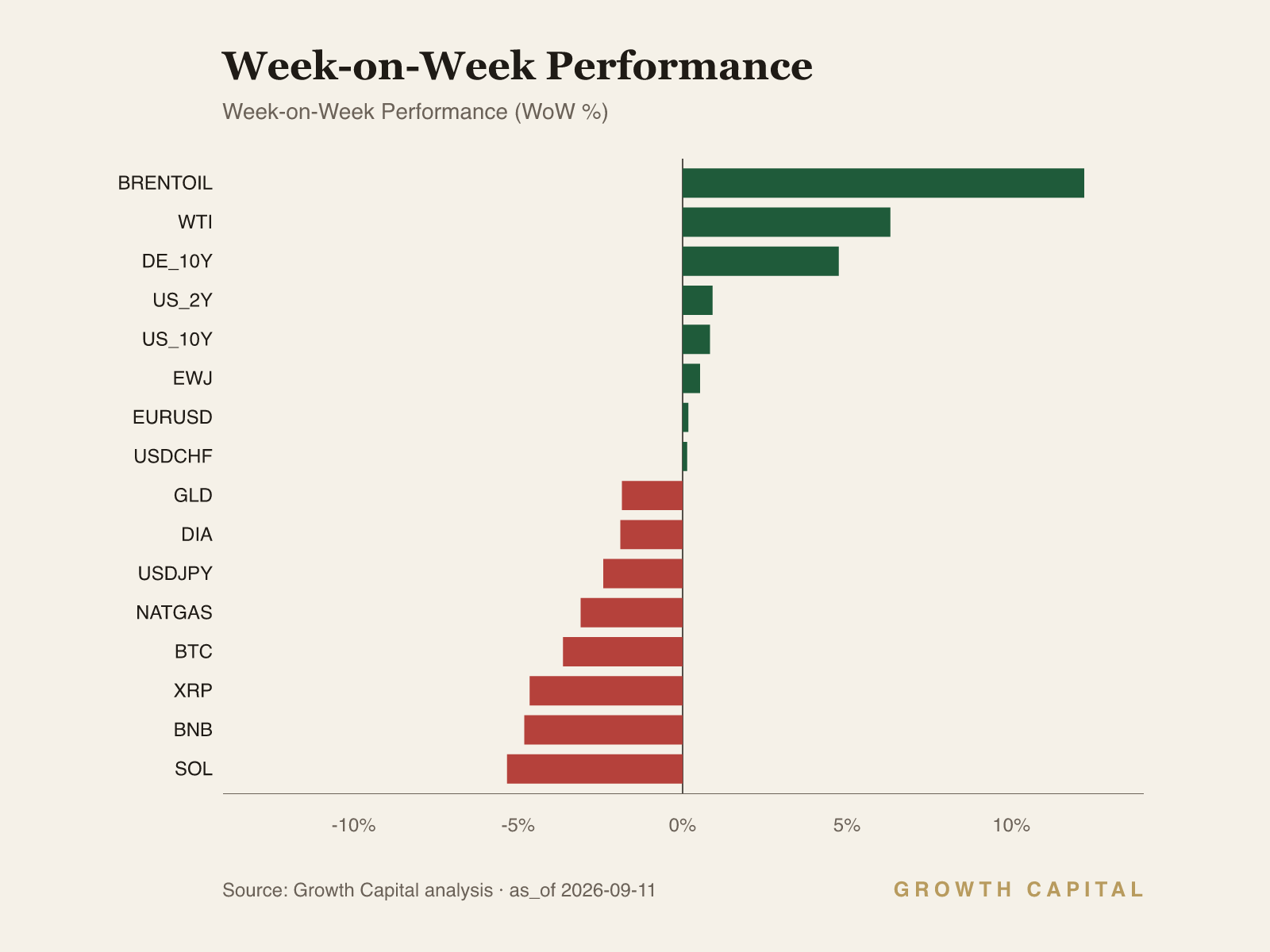
The energy shock has moved into the rates market. The US 10Y ended the week at 4.83% and the 2Y at 4.43%, both 52-week highs, with the German Bund at 3.53% after the ECB's 25bp hike to a 2.50% deposit rate.
Equities are absorbing the discount-rate reset unevenly. SPY fell -1.0% WoW to $765.39 while HYG sits 0.2% above its 52-week low at $78.82; credit, not equity, is pricing the regime.
Gold and bitcoin confirm the real-rate squeeze. BTC dropped -3.6% WoW to $77,398.7 alongside $449.5M of spot-ETF outflows over three sessions, and GLD fell -1.8% despite the geopolitical backdrop.
Our positioning: An energy supply shock is repricing the discount curve; we cut duration and hold equity beta at neutral until credit finds a floor.
Supply-shock inflation resets the discount curve; credit is the cleaner signal than equities
Our regime read is a stagflation lean with a hawkish repricing: an energy supply shock is passing into inflation expectations while central banks are forced back into tightening. The US 10Y ended the week at 4.83% and the 2Y at 4.43%, both 52-week highs, and the German Bund reached 3.53% after the ECB raised its deposit rate 25bp to 2.50% on 10 September. Growth is still standing, with August payrolls up 162,000 and unemployment at 4.1%, which is precisely what allows policy to lean hawkish into the shock. Equities gave ground but not proportionately: SPY fell -1.0% WoW to $765.39, still +12.0% YTD and only 1.6% below its 52-week high of $777.88. Credit is less forgiving, with HYG at $78.82 sitting 0.2% above its 52-week low and LQD -4.9% YTD. GLD fell -1.8% WoW despite the geopolitical backdrop, and BTC lost -3.6%. The pattern is coherent once the discount rate is placed at the centre: every long-duration claim repriced lower, every inflation-sensitive claim repriced higher. We are underweight duration, neutral on equity beta, and we treat credit as the week's honest signal.
The rates move is the week's primary fact. The 10Y at 4.83% and the 2Y at 4.43% both sit at the top of their 52-week ranges, up +15.3% and +27.7% YTD in yield terms, and the move dragged TLT down -0.9% WoW to $81.34, within 0.7% of its 52-week low of $80.78. The Bund at 3.53% is also at a 52-week high, so this is a global repricing, not a Treasury-specific event. The transmission runs from energy to producer prices to the policy reaction function to term premium: the August PPI printed +0.4% MoM and +5.4% YoY, and with crude sharply higher the market has moved from pricing cuts to pricing renewed hikes against a 3.63% funds rate. The ECB has already acted, and sources point to a BoJ hike of 25bp to 1.25% next week; when three major central banks tighten into the same supply shock, the long end must rebuild inflation compensation. The shape of the move carries information: the 10Y at 4.83% versus the 2Y at 4.43%, a 40bp gap, held its slope while both legs rose, which is inflation-premium behaviour rather than recession pricing. We are underweight duration on a three-to-six-month horizon, expressed through TLT, accepting the trade-off of forgone carry and of missing the first leg of any growth-scare rally. A 10Y close back below 4.43%, today's 2Y level, would invert the call; it would tell us the market has judged the energy move a one-time level shift the Fed can look through, and we would return duration to neutral.
The cross-asset tape splits. SPY fell -1.0% WoW, DIA -1.9%, IWM -1.4% and FEZ -1.1%, with EWJ the lone gainer at +0.5%; yet SPY remains +12.0% YTD and QQQ +16.7%, both in uptrends. Credit shows no such composure: HYG at $78.82 is 0.2% above its 52-week low of $78.62, LQD is -4.9% YTD, and EMB fell -0.8% WoW. The channel is rates to duration to multiples. A discount rate at a 52-week high compresses the present value of long-dated cash flows first, and spread product reprices immediately because its coupon competes directly with a 4.83% risk-free rate; equities, where index earnings concentrate in a handful of cash-rich mega-caps, can defer the repricing while flows and momentum hold. That deferral is a positioning statement: crowded equity longs have not liquidated, so realised volatility stays contained even as the funding-cost gauge sits on its lows. Credit confirms the P1 regime and the equity tape contradicts it; we resolve the tension in credit's favour because HYG within 0.2% of its low is a cleaner read than SPY 1.6% off its high. We hold equities at neutral, underweight small caps whose borrowers face a 4.43% front end, and underweight high yield. An HYG close below $78.62 moves us to underweight equities outright; SPY reclaiming $777.88 with the 10Y stable would tell us earnings are carrying the repricing and neutrality is too cautious.
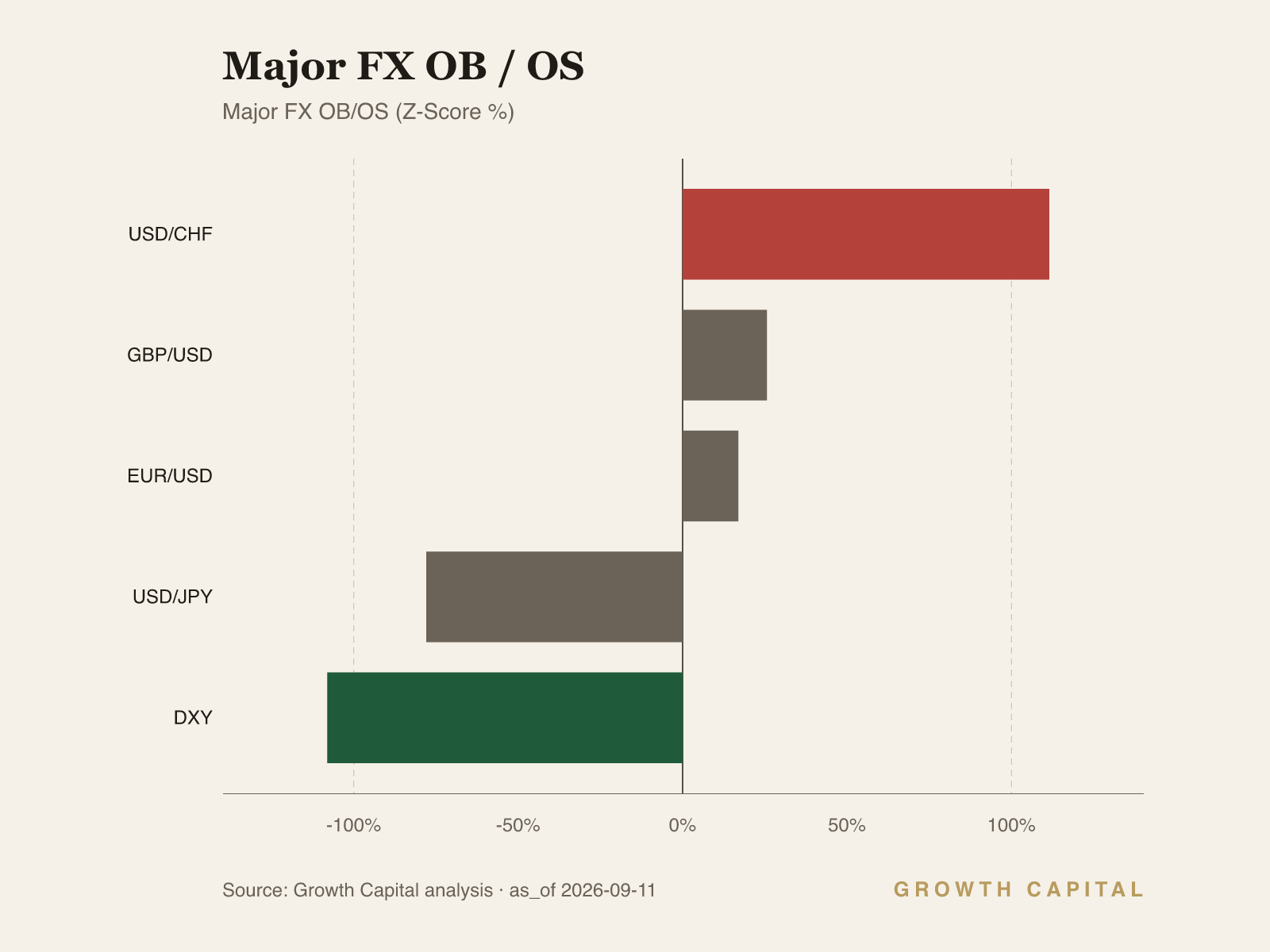
The dollar is the week's most informative dissent. DXY fell -0.6% WoW to 118.07, slightly oversold and -1.3% YTD, while USD/JPY dropped -2.4% to 156.11 and EUR/USD firmed +0.2% to 1.1618. A dollar that cannot rally when Treasury yields sit at 52-week highs is a term-premium signal: the yield rise reflects compensation for inflation and fiscal risk rather than US growth exceptionalism, so it attracts no marginal capital. Policy convergence compounds the move; with the ECB at a 2.50% deposit rate and the BoJ expected at 1.25%, rate differentials compress and the carry that funded long dollar-yen positions decays. A crowded carry unwind is a liquidity event in waiting, which links FX back to the P1 risk stance: yen strength alongside credit weakness is risk-off coherence, not noise. We are underweight USD/JPY and underweight the dollar broadly.
Our falsifiers are specific. On the downside, an HYG close below its 52-week low of $78.62 with the 10Y holding at or above 4.83% confirms the stagflation lean; we would cut equities to underweight and extend the duration underweight, and a TLT break of $80.78 would carry the same message from the rates side. On the upside, next week's CPI print is the pivot. A benign reading that takes the 10Y back below 4.43%, today's 2Y level, while SPY reclaims $777.88 would tell us the shock is a level effect a resilient earnings base can absorb, and we would restore duration to neutral and revisit equity overweights. USD/JPY through its 52-week low of 146.36 would flag a disorderly carry unwind, a separate and worse scenario than either.
Source: GrowthCapital analysis; market data per snapshot feeds (FRED, ETF proxies), ECB and BLS releases, Nansen on-chain intelligence, SoSoValue ETF flow data.
Fixed Income
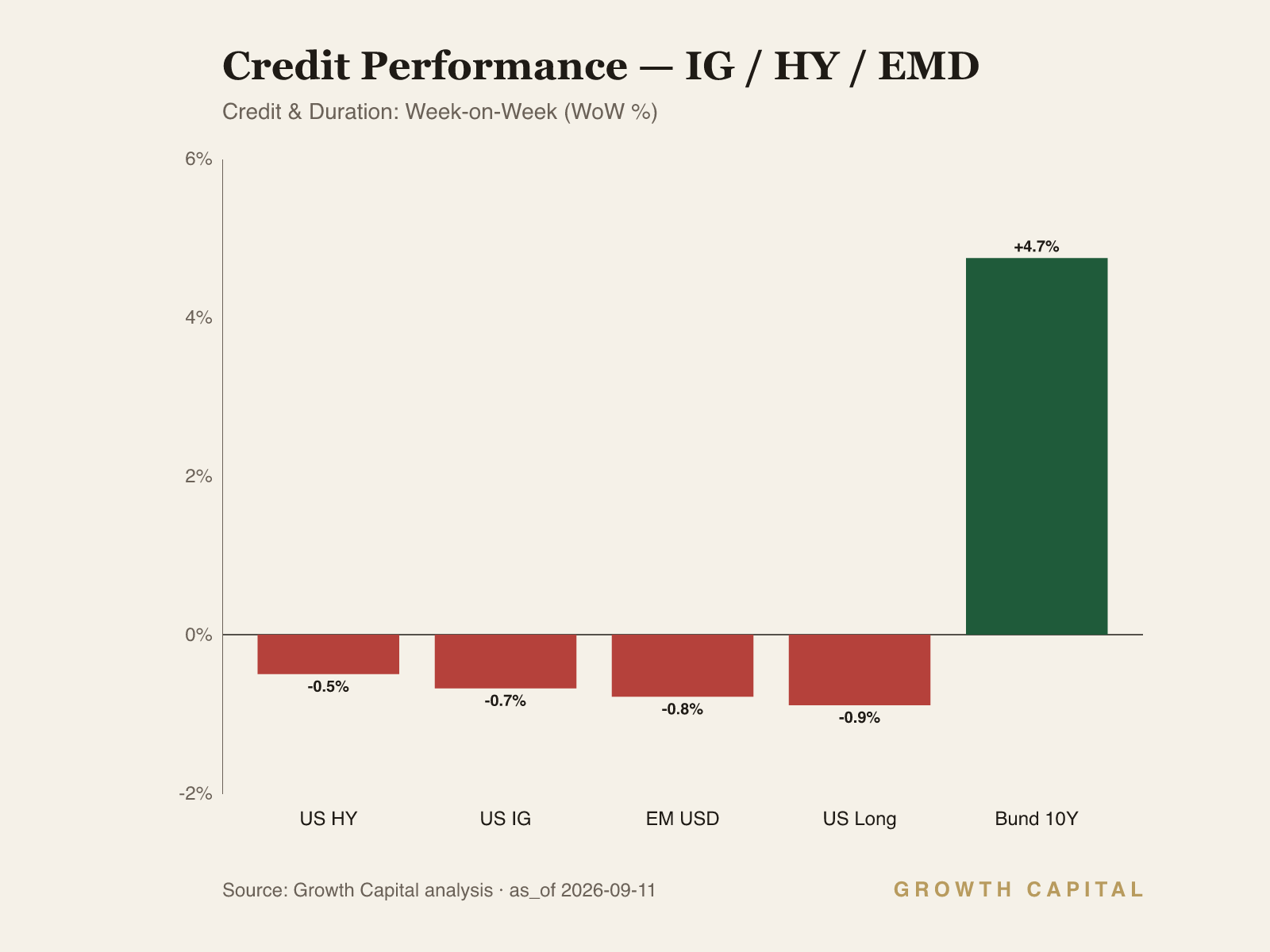
The 10Y at 4.83% and the 2Y at 4.43% both ended the week at 52-week highs, up +15.3% and +27.7% YTD in yield terms, and the German Bund followed to 3.53%, its own high, after the ECB lifted its deposit rate 25bp to 2.50%. TLT fell -0.9% WoW to $81.34 and is -6.5% YTD, within 0.7% of its $80.78 low. The mechanism is a term-premium rebuild: an energy shock feeding a +5.4% YoY producer-price print forces markets to price renewed tightening against a 3.63% funds rate, and long bonds must offer more inflation compensation precisely when appetite for duration is weakest. The curve's behaviour is the tell. The 10Y at 4.83% versus the 2Y at 4.43% keeps a 40bp positive gap even as both legs rise, so the market is pricing persistent inflation, not imminent recession. Credit transmits the same message with less noise: LQD at $104.79 is -4.9% YTD and less than 0.5% above its 52-week low of $104.36, while HYG at $78.82 sits 0.2% above $78.62. When high yield makes new lows while equities hold within 2% of their highs, we side with high yield. We are underweight duration, underweight HY, and neutral IG, where the slightly oversold reading and the coupon reset offer adequate compensation for the spread risk. A 10Y close back below 4.43%, the current 2Y level, returns us to neutral duration; an HYG break of $78.62 extends every underweight in this section.
Equities
US equities fell for the week with dispersion that maps directly onto rate sensitivity: DIA -1.9% WoW, IWM -1.4%, SPY -1.0% to $765.39, and QQQ just -0.3%. Abroad, FEZ lost -1.1% as the ECB hiked into an energy shock, while EWJ added +0.5% to $98.42, essentially at its 52-week high of $98.47. The mechanism is the discount-rate channel operating on unequal balance sheets. Small caps carry floating-rate debt priced off a 4.43% front end, so IWM's +17.0% YTD cushion is the most exposed to the repricing; the mega-cap complex behind QQQ's +16.7% YTD funds itself from operating cash flow and can defer the multiple compression. Japan is the exception with a local driver: a BoJ moving to 1.25% strengthens the yen, and for a USD-denominated proxy such as EWJ that currency appreciation adds to local returns, which is why it printed the only green number among the majors. Positioning matters as much as earnings here. Crowded index longs have not liquidated, which keeps realised volatility low but leaves the tape one credit event away from a faster repricing, and HYG's proximity to its 52-week low says the funding market has already voted. We hold SPY and QQQ at neutral, move IWM to underweight, keep FEZ neutral given its +6.7% YTD lag and energy-import exposure, and are overweight EWJ. A SPY reclaim of $777.88 with the 10Y off its 4.83% high restores our appetite for beta; an HYG close below $78.62 cuts us to underweight across the board.
Commodities
Crude is the shock's origin. WTI rose +6.3% WoW to $97.26 and is +70.0% YTD, though our secondary source prints $96.01, a 1.3% divergence beyond tolerance, so we treat the level as approximate and the direction as the signal. Supply disruption around the Strait of Hormuz and strikes in Yemen have put a risk premium into every barrel, and the pass-through is already visible in the +5.4% YoY producer-price print and in record US diesel prices reported into the weekend. The mechanism from here is circular: higher crude lifts inflation expectations, which lifts yields, which tightens financial conditions, which eventually rations demand. After a year-to-date move of this size, a substantial part of that demand-destruction phase is being priced in real time, which caps the appeal of chasing strength. Gold is the week's most instructive commodity precisely because it fell. GLD lost -1.8% WoW to $402.64 and is just +1.1% YTD, despite a geopolitical backdrop that would normally command a safe-haven premium. The explanation is the real-rate channel: with the 10Y at 4.83%, the opportunity cost of holding a zero-coupon store of value has risen faster than the fear premium, and the marginal buyer steps back. We are neutral energy after the move, unwilling to chase a supply premium that can deflate as quickly as it built, and neutral gold. We turn constructive on gold if the 10Y retraces below 4.43%, and we revisit an energy underweight only on evidence of shipping-lane normalisation.
Forex
The dollar's failure to rally is the week's cleanest macro tell. DXY fell -0.6% WoW to 118.07, is -1.3% YTD and slightly oversold, even though US yields sit at 52-week highs; USD/JPY dropped -2.4% to 156.11 and EUR/USD firmed +0.2% to 1.1618. In a growth-led yield rise, capital chases the higher rate and the currency appreciates; when yields rise on inflation and term-premium fear while the currency softens, the market is charging the US a risk premium rather than paying it for growth. The policy channel compounds the move. The ECB's 25bp hike to a 2.50% deposit rate and an expected BoJ move to 1.25% compress the rate differentials that funded the long-dollar carry complex, and the yen's -2.4% weekly move in the pair is the first instalment of that unwind. Positioning is the amplifier: years of accumulated dollar-yen carry mean short-covering feeds on itself once the differential narrative breaks, and a disorderly unwind would transmit into risk assets through forced deleveraging. We are underweight USD/JPY and underweight the dollar broadly, and neutral EUR/USD, where the ECB's hike is offset by the euro area's energy terms-of-trade deterioration and a -1.0% YTD tape. USD/JPY through its 52-week low of 146.36 would tell us the unwind has turned disorderly and we would raise portfolio hedges; renewed dollar strength alongside stable credit would return us to neutral on DXY and confirm the yield move as growth-led after all.
GC Views
| Asset | View | Rationale |
|---|---|---|
| US_10Y | UW | 4.83%, a 52w high; energy pass-through is still building term premium, we stay short duration. |
| US_2Y | UW | 4.43%, a 52w high, +27.7% YTD; the front end is repricing hike risk against a 3.63% funds rate. |
| DE_10Y | UW | 3.53%, a 52w high with the ECB at 2.50% and still hiking; Bunds are no hedge to Treasury duration. |
| TLT | UW | $81.34, -6.5% YTD, 0.7% above the $80.78 low; no floor until the inflation impulse breaks. |
| HYG | UW | $78.82, 0.2% above the 52w low of $78.62; high yield is pricing the regime equities defer. |
| SPY | N | -1.0% WoW to $765.39, 1.6% off the high; +12.0% YTD earns neutrality with credit on its lows. |
| QQQ | N | -0.3% WoW, the most resilient major; mega-cap cash flow defers, not escapes, the multiple reset. |
| IWM | UW | -1.4% WoW; floating-rate borrowers meet a 4.43% front end and the +17.0% YTD cushion can give back. |
| EWJ | OW | +0.5% WoW to $98.42, at the 98.47 high; BoJ tightening adds yen appreciation to unhedged returns. |
| GLD | N | -1.8% WoW to $402.64; a 4.83% 10Y raises carry cost faster than the fear premium builds. |
| BTC | UW | -3.6% WoW to $77,398.7 with $449.5M ETF outflows; longest-duration asset, steepest discount penalty. |
| EURUSD | N | 1.1618, +0.2% WoW; the ECB's 25bp hike offsets the energy terms-of-trade drag. |
On-Chain Pulse
The week's aggregate on-chain pattern is a spot-versus-perps split: perpetual order flow was net-sell in four of the five majors, yet Hyperliquid smart traders held net-long positioning in BTC, ETH, SOL and XRP. The strongest accumulation signal was exchange outflow in native ETH and BNB, while profitable-wallet activity was distributive in wrapped BTC, SOL and BNB. Nansen's fund-labelled spot netflow returned no quantified figure for any of the five assets this week, a coverage gap we flag rather than read as zero fund activity.
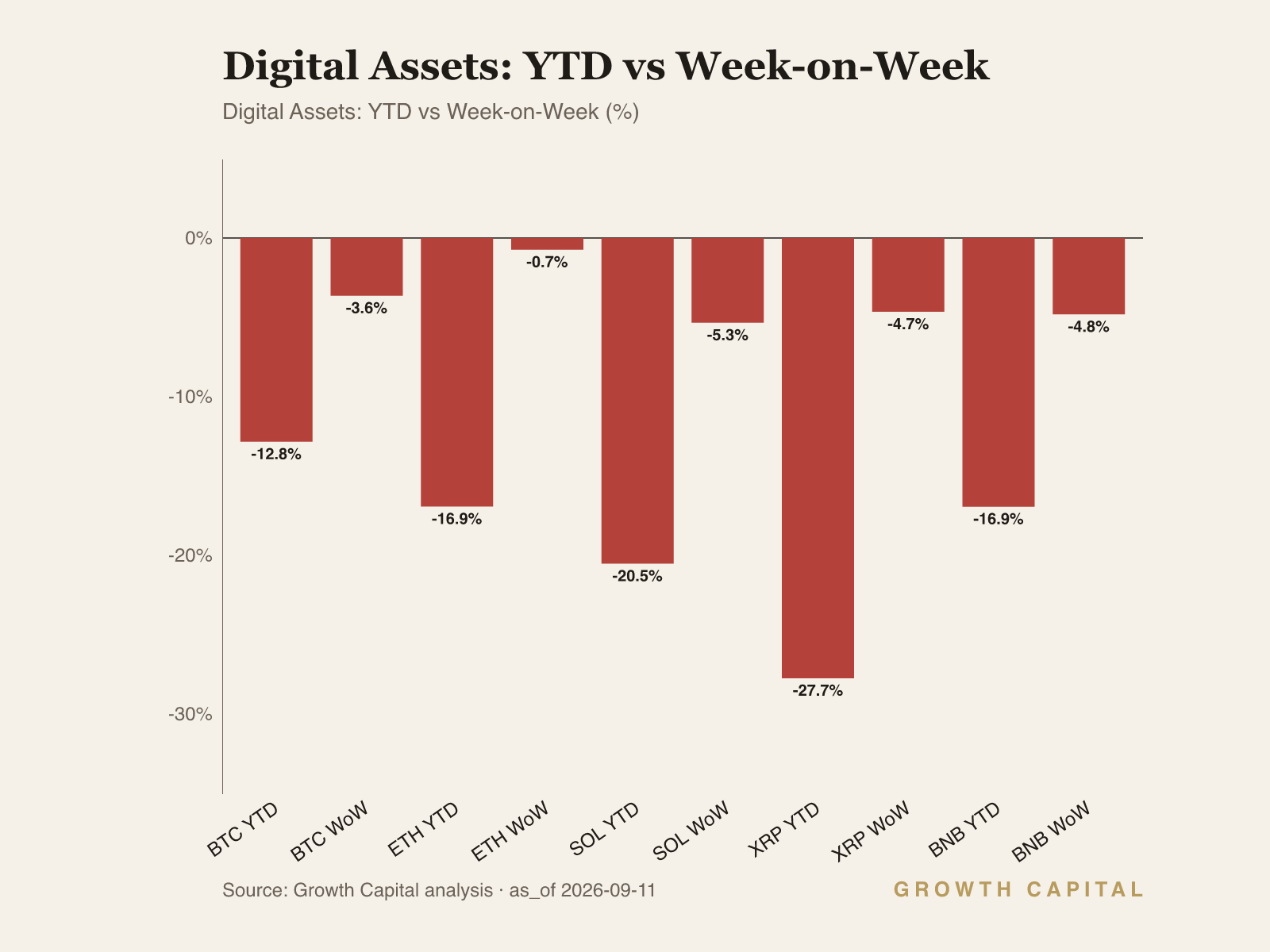
Bitcoin fell -3.6% WoW to $77,398.7 and is -12.8% YTD, with dominance at 56.2% of a $2.77T total market on $180.4B of daily volume. The cohort split is the story: smart traders on Hyperliquid remain net long the BTC perp, while WBTC on Ethereum showed distributive activity from profitable wallets, a spot-versus-perps divergence in which the leveraged cohort holds conviction the spot profit-takers do not share. The ETF channel sided with the spot sellers: US spot bitcoin ETFs lost $449.5M across 8-10 September, $282.7M of it on 10 September alone, with ARKB accounting for $164.3M of withdrawals, GBTC $36.4M and FBTC $33.6M. Perpetual order flow was net-sell alongside. With the 10Y at 4.83%, the longest-duration risk asset carries the steepest discount-rate penalty. We stay underweight until ETF flows stabilise for at least a full week.
Ethereum was the most resilient major, down just -0.7% WoW to $2,495.47, though still -16.9% YTD. Native ETH posted the week's strongest exchange-outflow signal, coins moving off exchange into self-custody, which historically reads as accumulation rather than sale preparation. Smart traders on Hyperliquid are net long the ETH perp, so spot and leveraged positioning agree here, in contrast to BTC's split. Aggregate perp order flow was still net-sell, which caps the near-term read, and no fund-labelled netflow figure was available to size institutional participation. The relative-strength case is the cleanest in the complex: the -0.7% weekly print against SOL's -5.3% and BNB's -4.8% matches the on-chain alignment. We hold ETH at the top of our digital-asset preference order while keeping the asset class underweight overall.
Solana fell -5.3% WoW to $100.81 and is -20.5% YTD, the weakest weekly print among the majors apart from BNB. The cohort signals conflict: smart traders hold net-long perp positioning on Hyperliquid, but profitable wallets were distributive in spot SOL, the same divergence pattern as wrapped BTC. Perpetual order flow was net-sell, so the marginal flow runs against the smart-trader book. When leveraged longs sit against distributive spot flow, the resolution usually comes through the leverage rather than the spot. We hold no position and see no entry until spot distribution stops; a -20.5% YTD tape with profitable sellers still active is not a level to fade.
XRP lost -4.7% WoW to $1.3569 and is -27.7% YTD, the worst year-to-date print in the complex. Smart traders are net long the Hyperliquid perp, one of the four majors where that cohort holds conviction. Spot coverage is representation-specific this week, read through CBXRP on Base, a thin proxy we discount accordingly. Perpetual order flow was net-sell, in line with the complex-wide pattern. A net-long smart-trader book against a -27.7% YTD downtrend is a contrarian signal we respect but do not act on. We hold no position and would revisit only if the broader digital sleeve turns.
BNB dropped -4.8% WoW to $717.07 and is -16.9% YTD. It carries the week's most contradictory signature: native BNB shared the strongest exchange-outflow accumulation signal with ETH, yet profitable-wallet activity was distributive and BNB is the one major where Hyperliquid smart traders do not hold a net-long perp position. Perpetual order flow was net-sell here as well. Read together, coins are leaving exchanges but the sophisticated cohort is not underwriting the move, which suggests custody migration rather than conviction accumulation. We hold no BNB and require smart-trader alignment before that changes.
What We're Watching
Four thresholds govern our stance. First, HYG at $78.82 versus its 52-week low of $78.62: a close below moves us to underweight equities outright. Second, the 10Y at 4.83%: a retracement below 4.43%, today's 2Y level, returns duration to neutral and restores gold's bid. Third, SPY at $765.39 versus its $777.88 high: a reclaim with rates stable says earnings are absorbing the shock and our neutrality is too cautious. Fourth, USD/JPY at 156.11 versus its 52-week low of 146.36: a break there flags a disorderly carry unwind and we raise hedges. Next week's US CPI print and the BoJ decision are the catalysts most likely to hit these levels first; a TLT break of $80.78 would confirm the downside path from the rates side.
This Week in Charts