The long end sets the regime. The US 10Y closed at 5.29%, a 52-week high and +3.5% WoW, while the 2Y at 4.88% barely moved, a term-premium rebuild rather than a Fed-path repricing.
Credit confirms what equities deny. LQD (-7.1% YTD) and HYG (-4.4% YTD) sit within cents of 52-week lows while QQQ printed a 52-week high at 750.55, +22.4% YTD; we side with credit.
The dollar collects the differential. DXY rose +0.7% WoW to 120.33 on a 167bp gap between the US 10Y at 5.29% and the Bund at 3.62%, pinning EUR/USD at 1.14 and pushing gold -2.3% WoW.
Our positioning: Credit at 52-week lows is the honest read on a 5.29% 10Y; we respect the rate regime and fade equity breadth, not the Nasdaq.
The long end leads, credit confirms, and equity strength narrows to one trade
The week's regime is a hawkish inflationary grind: central banks are tightening into an expansion, the long end is rebuilding term premium, and equity strength has narrowed to one concentrated trade. The US 10Y closed at 5.29%, a 52-week high and +3.5% WoW, while the Nasdaq-100 proxy printed its own 52-week high at 750.55, +22.4% YTD. That pairing, cycle-high discount rates against cycle-high growth equity, is the tension this note resolves. The Fed's September hike took the policy rate to 3.75% and the ECB tightened in parallel, both signalling data dependence rather than a pause. Credit is the tape we trust: investment grade is -7.1% YTD and high yield -4.4% YTD, both oversold and both within cents of 52-week lows. The dollar at 120.33, +0.7% WoW, says global capital sides with the bond market, and our read follows: the rate regime is real, the equity tape is narrow, and the honest cross-asset signal is defensive.
The observation first: the 10Y at 5.29% sits on its 52-week high, +3.5% WoW and +26.3% YTD, while the 2Y moved just +0.6% WoW to 4.88%, so the long end is leading and this is bear steepening, not a repricing of the Fed path. TLT confirmed in price, falling -1.8% WoW to $77.89, 18 cents above its $77.71 52-week low. The mechanism runs rates to duration to multiples, one link at a time. With the policy rate at 3.75% and the 2Y at 4.88%, the front end already prices a restrictive path; the incremental selloff is term premium, compensation for holding duration through heavy supply and inflation that has run above target for years, not a higher expected terminal rate. That rebuild passes mechanically into every long-dated cash flow: TLT's -10.5% YTD is the cleanest measure of the pass-through, and the same arithmetic reaches IG credit at -7.1% YTD and, eventually, the equity multiple that has so far refused to compress. The implication: we are underweight long duration on a one-to-three-month horizon and prefer the front end, where the 2Y at 4.88% against the 10Y at 5.29%, a 41bp gap, collects most of the curve's yield with a fraction of its price risk. The trade-off we accept is reinvestment risk and missing the first leg of a rally from cyclical yield highs. The change-of-view trigger: a 2Y rejected at its 4.92% 52-week high alongside soft labour data would say the cycle is fully priced and term premium has peaked, and we would move duration to neutral. A fresh 10Y high with the 2Y stalled would confirm the term-premium read and keep the underweight on.
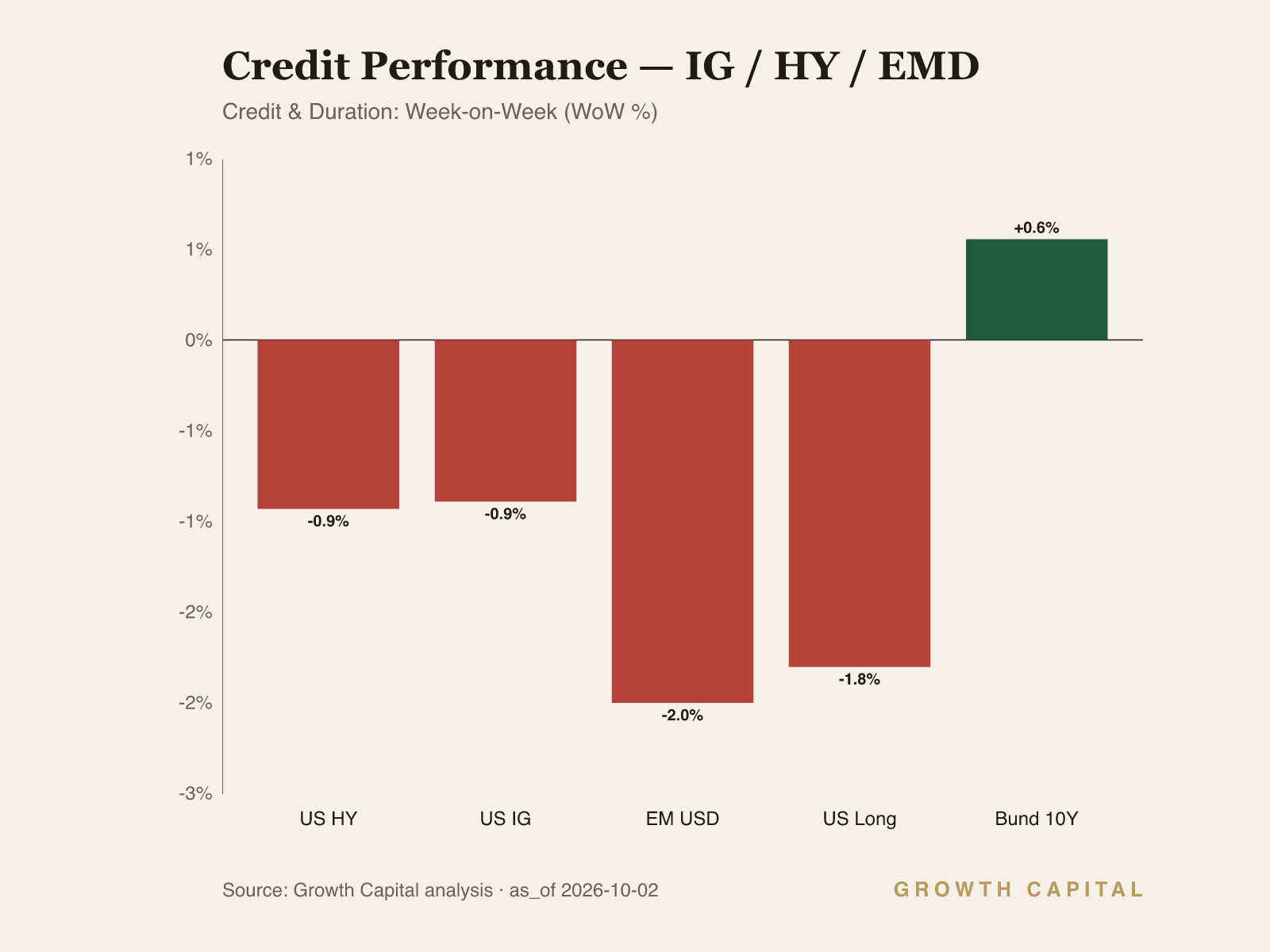
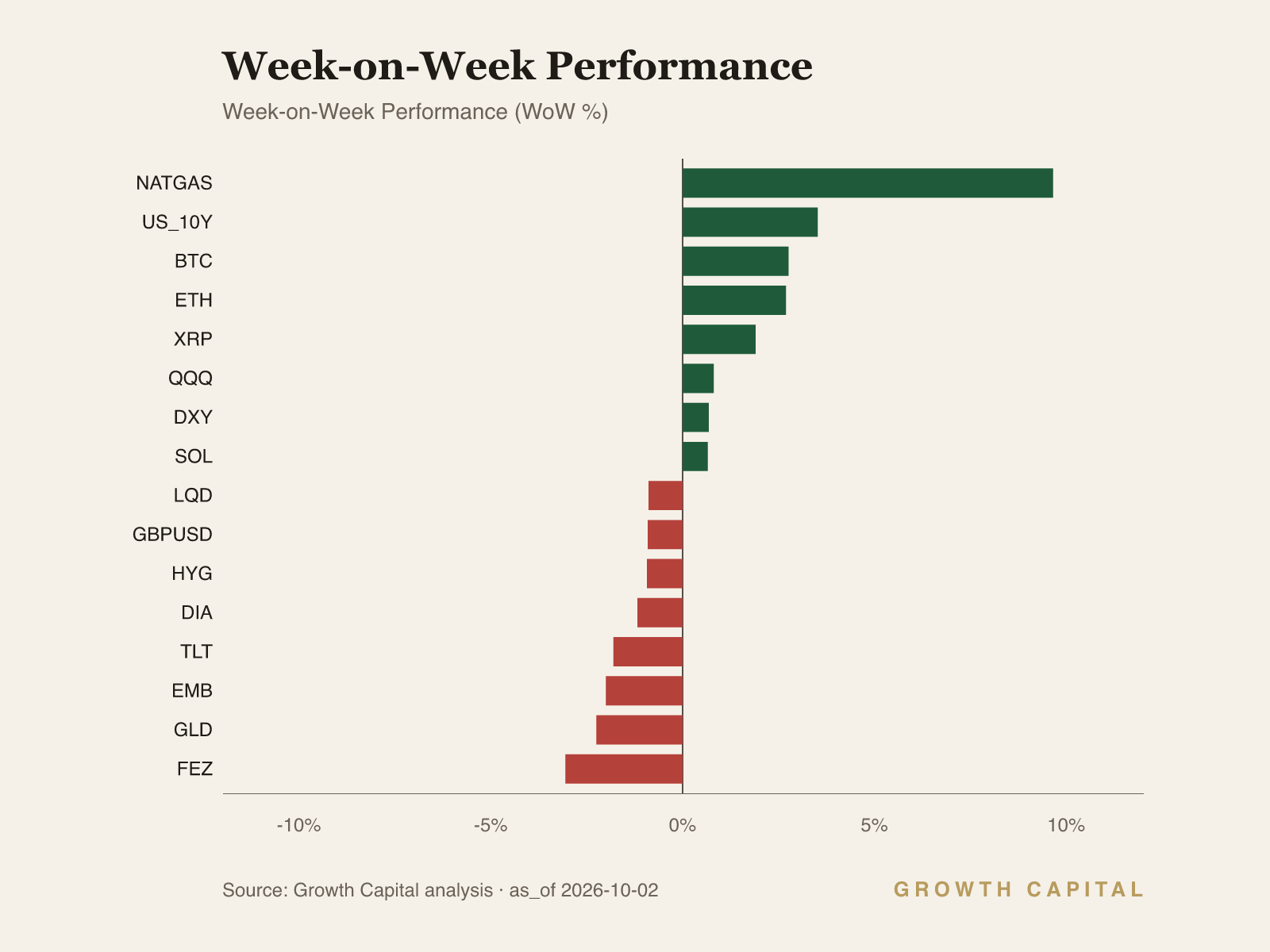
Cross-asset, credit confirms the regime read and the equity tape contradicts it; the contradiction resolves against equities. QQQ closed at a 52-week high of 750.55, +0.8% WoW, and SPY held 770.15, -0.2% WoW and +12.7% YTD, while LQD fell -0.9% WoW to $102.29 and HYG -0.9% WoW to $77.14, each within 30 cents of its 52-week low. The mechanism is positioning and breadth. Credit is duration plus spread, so the Treasury selloff transmits directly into IG prices with no earnings story to offset it, while the equity multiple is defended by a concentrated AI-earnings narrative funnelling capital into a handful of self-funding mega-cap balance sheets. Leverage-constrained investors crowding high-beta growth is a documented pattern, and it is the behaviour that flattens the risk-return line when funding costs rise. Breadth quantifies the crowding: DIA fell -1.2% WoW, FEZ -3.1% WoW and EM dollar sovereigns -2.0% WoW, so four of the six major tapes we track sided with credit over the Nasdaq. The implication: we hold SPY at neutral, pair an overweight in QQQ against an underweight in FEZ, and treat it as a breadth position rather than a beta add; the trade-off is being long the crowd in the one place its fundamentals are real. The change-of-view trigger: HYG through its $76.90 52-week low would say the duration repricing is turning into a credit event, and we would cut equity beta outright. A QQQ failure at 750.55 with yields at highs carries the same message from the other side.
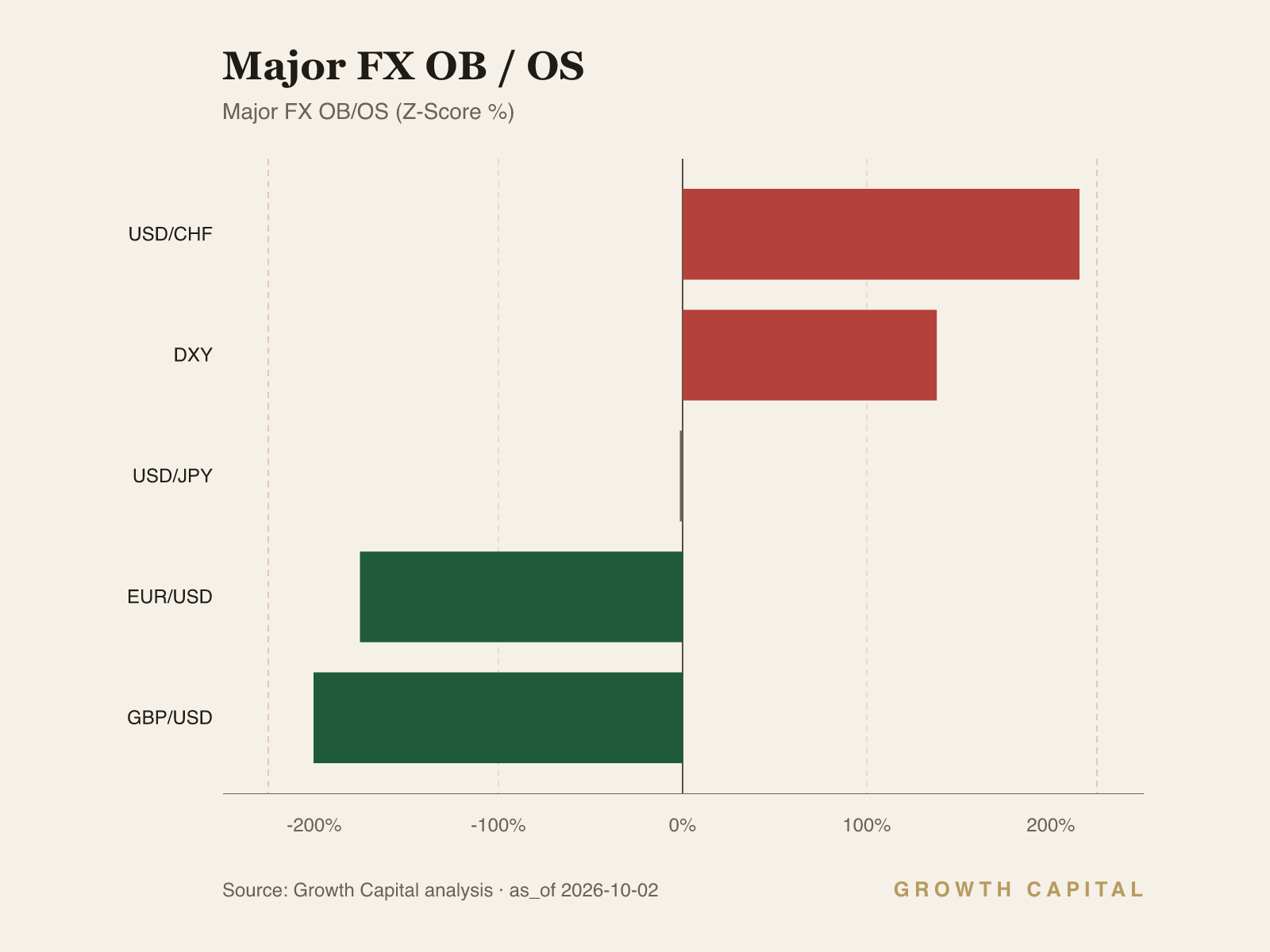
The second rail is FX, the cleanest expression of the regime. DXY rose +0.7% WoW to 120.33, within 1.3% of its 121.92 52-week high, while EUR/USD at 1.14 sits on its 1.1348 low and sterling fell -0.9% WoW to 1.325. The channel is the rate differential: the US 10Y at 5.29% against the Bund at 3.62% is a 167bp gap, capital crosses the Atlantic to collect it, and the euro absorbs the pressure while European financial conditions tighten into an already weak equity tape. Gold runs the same mechanism from the other side, -2.3% WoW to $384.55 and -3.4% YTD, a zero-yield asset losing the carry contest to cycle-high nominal rates. On energy, our primary feed prints Brent at $113.96/bbl but a cross-check source diverges by roughly 13%, so we flag the discrepancy and withhold a tactical crude view until the feeds reconcile. The coherence test comes back risk-off: dollar up, gold down on rates, credit at lows, equity leadership narrowing; every rail but the Nasdaq agrees with the regime statement.
Our falsifiers are levels, not moods. Downside: HYG through $76.90 and LQD through $102.03, with EMB breaking $90.26 in sympathy, would say the duration shock is becoming a solvency question; we would cut equity beta, close the QQQ overweight and revisit gold, whose role shifts from carry loser to hedge in that scenario. Upside: a 2Y rejected at its 4.92% high alongside softening labour data (unemployment already at 4.2%) would signal peak term premium; we would add duration through TLT near its $77.71 low and lift equities toward overweight as discount-rate pressure fades. A EUR/USD close below 1.1348 deepens the European underweight rather than reversing anything. Until one of those levels prints, the stack stands: underweight duration, neutral equity beta with a quality tilt, underweight Europe and gold, dollar strength respected. Friday's payrolls report is the proximate catalyst for every leg.
Source: GrowthCapital analysis; market data per GC snapshot feeds; on-chain data from Nansen and Hyperliquid.
Fixed Income
The Treasury curve bear-steepened to cycle extremes, and fixed income is where the week's information lives. The 10Y at 5.29% is a 52-week high, +3.5% WoW and +26.3% YTD; the 2Y rose just +0.6% WoW to 4.88%, below its 4.92% high, leaving a 41bp gap between the 10Y at 5.29% and the 2Y at 4.88%. The split matters because the front end is anchored by the 3.75% policy rate while the long end moves on term premium, so the selloff is about duration compensation, not a higher terminal rate. The pass-through is visible in price: TLT fell -1.8% WoW to $77.89, 18 cents above its $77.71 52-week low, and is -10.5% YTD, the purest duration loss in the complex. Credit tells us the selloff is still a rates event rather than a default event: LQD at $102.29 is -7.1% YTD while HYG at $77.14 is -4.4% YTD, and high yield outperforming investment grade by 2.7 points YTD is what shorter duration looks like, not what spread widening looks like. Our positioning follows the mechanism: underweight the 10Y and TLT, underweight LQD on pure rate risk, underweight HYG as the instrument closest to a regime-defining break, and neutral the 2Y, where 4.88% pays for patience. We would reverse on a 2Y rejection at 4.92% with soft labour data; we would turn outright defensive on an HYG close below $76.90, which would say default risk has joined duration risk.
Equities
Equity indices disagree with each other as much as with bonds. QQQ closed at its 52-week high of 750.55, +0.8% WoW and +22.4% YTD, while SPY slipped -0.2% WoW to 770.15 (+12.7% YTD) and the European proxy FEZ fell -3.1% WoW, holding just +1.8% YTD. Japan is the quiet exception: EWJ rose +0.6% WoW to 98.57, within a point of its 98.78 52-week high and +21.2% YTD, with the yen at 157.18 still subsidising exporter earnings. The mechanism separating winners from losers is sensitivity to the discount rate versus the strength of the earnings offset. Mega-cap US growth carries an AI-earnings story and self-funding balance sheets that can absorb a 5.29% 10Y; Europe carries neither and imports the US rate shock through a 167bp gap between the 5.29% Treasury and the 3.62% Bund, plus an energy bill; Japan runs its own monetary regime with a currency doing the easing. We are overweight QQQ and EWJ, neutral SPY, and underweight FEZ; the trade-off is concentration risk in the QQQ leg, where we are knowingly long a crowded position because the cash flows behind it are real. The falsifier is explicit: a QQQ rejection at 750.55 while HYG breaks $76.90 would tell us the crowding is unwinding into a credit event, and we would cut the overweight and take SPY below neutral rather than rotate within equities. Until then, breadth is the risk we are paid to monitor, and the pair structure is how we carry it.
Digital Assets
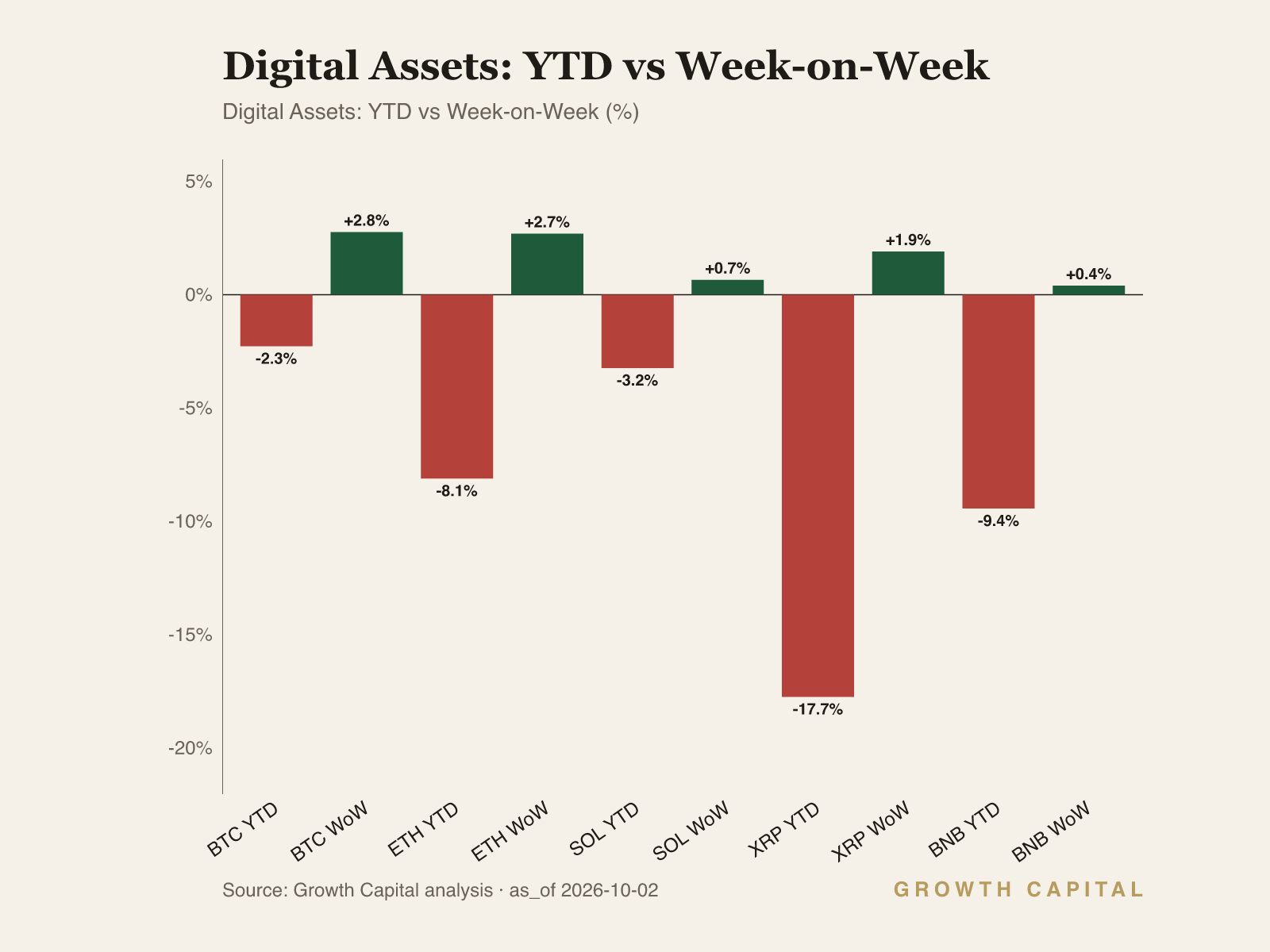
Crypto is rallying into a 5.29% 10Y, which is itself the signal. Bitcoin rose +2.8% WoW to $86,777 against a 52-week high of $89,255.8, with ETH +2.7% WoW to $2,760.17 and total market cap at $3.08T, +3.0% over 24 hours on $187B of daily volume. BTC dominance at 56.51% says the bid is majors-led, which is what defensive positioning looks like inside the asset class, and every major screens slightly overbought after the week's move. The mechanism supporting the tape is on-chain rather than macro: wrapped-BTC proxies show top-PnL wallets +$13.2M net against a -$14.4M exchange netflow, and ETH recorded -$109.1M of exchange withdrawals, the largest such signal across the majors, so coins are leaving exchange custody while price grinds higher, a supply-side support that does not depend on rate relief. The tension is that ETH's most profitable cohort sold -$15.5M net even as smart traders added +$217.9k, so the strong hands are not unanimous. We hold BTC and ETH at neutral: the structural flow is constructive, but adding exposure at slightly overbought readings while the discount rate sits at cycle highs is a trade we decline, with YTD still negative at -2.3% for BTC and -8.1% for ETH. A BTC close through $89,255.8 on continued exchange outflows would move us to overweight on momentum; a rejection there with leverage returning to the derivatives tape would cut us to underweight.
GC Views
| Asset | View | Rationale |
|---|---|---|
| US_10Y | UW | 5.29% is a 52w high driven by term premium; +3.5% WoW momentum argues against catching duration yet |
| US_2Y | N | 4.88% against the 4.92% 52w high prices the 3.75% policy rate; best carry per unit of price risk |
| TLT | UW | -10.5% YTD at $77.89, 18 cents above the 52w low; we add only on a 2Y rejection at 4.92% |
| LQD | UW | -7.1% YTD is pure duration pass-through; IG carries the rate shock with no earnings offset |
| HYG | UW | $77.14 sits 24 cents above the $76.90 52w low; that break is our regime trigger and we stay ahead of it |
| SPY | N | +12.7% YTD rests on narrow leadership; credit at 52w lows caps our willingness to add beta |
| QQQ | OW | 52w high at 750.55, +22.4% YTD; self-funding mega-cap earnings absorb the 5.29% discount rate |
| FEZ | UW | -3.1% WoW and only +1.8% YTD; Europe imports the US rate shock through a 167bp Bund gap |
| BTC | N | +2.8% WoW to $86,777 with exchange outflows; slightly overbought below the $89,255.8 high, add on a break |
| ETH | N | -$109.1M left exchanges but top-PnL wallets sold -$15.5M net; flow supports the floor, not an add |
| EURUSD | UW | 1.14 sits on the 1.1348 52w low against a 167bp 10Y-Bund gap (5.29% vs 3.62%) |
| GLD | UW | -2.3% WoW to $384.55; zero yield loses the carry contest to a 5.29% 10Y and a 120.33 dollar |
On-Chain Pulse
The week's on-chain pattern is a mixed cohort lean rather than broad accumulation: the clearest signals were exchange withdrawals in Ethereum and Solana, increased smart-money derivatives exposure in Bitcoin and Ethereum on Hyperliquid, and reduced exposure in Solana and BNB. Verified-fund activity was patchy, and the data does not support a claim of institutional accumulation across all majors. XRP coverage in this window is limited to its BNB-chain representation rather than the native ledger, so we omit it rather than stretch a proxy.
Bitcoin's spot picture, read through wrapped proxies, is quietly constructive. On WBTC, top-PnL wallets were net buyers of +$13.2M over the seven-day window with no significant smart-trader flow, set against a -$14.4M exchange netflow; on CBBTC on Base, smart traders added +$44.6k and top-PnL wallets +$425.4k, with a -$22.3M exchange netflow that also carries issuance and redemption activity. The divergence that matters is spot versus venue custody: coins left exchange-labelled wallets while price rose +2.8% WoW to $86,777, so the marginal seller is not being resupplied from cold storage. On Hyperliquid, smart-money derivatives exposure increased on the week, aligning the levered cohort with the spot withdrawal pattern. The window returned direction but no whale-cohort dollar sizing and no funding print we can quote, and we flag that coverage gap rather than fill it. GC positioning: hold at neutral, with the add trigger a close through the $89,255.8 52-week high on continued outflows.
Ethereum carries the week's largest single flow signal and its sharpest internal split. Exchange netflow was -$109.1M over the window, the biggest withdrawal across the majors we track, consistent with coins moving toward self-custody rather than sale. The cohort detail cuts both ways: smart traders were modest net buyers at +$217.9k while top-PnL wallets distributed -$15.5M net, so the most profitable spot cohort sold into the +2.7% WoW move to $2,760.17. On Hyperliquid, smart-money derivatives exposure increased alongside Bitcoin's; as with BTC, the window supplied direction without whale dollar sizing or a quotable funding level, a gap we state explicitly. ETH remains -8.1% YTD against a 52-week high of $3,024.61, so the recovery has room before it meets prior supply. GC positioning: neutral; the withdrawal flow supports the floor, but we will not add while the asset's best-informed spot cohort is a net seller.
Solana splits spot and derivatives in the opposite direction from the majors above. Exchange withdrawals were among the week's clearest spot signals, yet smart-money derivatives exposure on Hyperliquid was reduced, so the levered cohort de-risked even as spot supply left venues. The window returned no smart-trader or whale dollar sizing for SOL spot cohorts and no quotable funding level, which limits how hard we can lean on the read. Price action was muted relative to peers: +0.7% WoW to $122.74, slightly overbought, against a 52-week high of $127.13 and -3.2% YTD. When the derivatives cohort pulls exposure while spot withdraws, the honest interpretation is hold, do not add: the supply side improves but the fast money is stepping back. GC positioning: neutral, no leveraged expression, reassessed only on a close through $127.13 with smart-money derivatives exposure turning back up.
BNB is the least supported major in the window. Smart-money derivatives exposure on Hyperliquid was reduced over the week, mirroring Solana, and the window carried no material spot cohort sizing, no whale dollar figure and no quotable funding level, so the signal set is thin and one-directional. The price tape matches the flow tape: +0.4% WoW to $781.83 was the weakest move among the majors, and the asset is still -9.4% YTD against a 52-week high of $901.67. An asset whose only measurable cohort action is derivatives de-risking, while peers show spot withdrawals, does not earn new capital. GC positioning: neutral with a negative lean; within a majors sleeve we would fund BTC or ETH exposure from BNB, and we would revisit only if smart-money exposure on Hyperliquid turns additive.
What We're Watching
Five levels govern the stack. HYG at $77.14: a close below its $76.90 52-week low converts the duration repricing into a credit event and we cut equity beta outright. The 2Y at 4.88%: rejection at the 4.92% high with soft labour data signals peak term premium and we add duration via TLT near $77.71. LQD at $102.29: a break of $102.03 confirms the downside scenario from the IG side. EUR/USD at 1.14: a close below 1.1348 deepens the European underweight. QQQ at 750.55: failure at the high while the 10Y holds 5.29% removes the one pillar under equity indices. In crypto, BTC through $89,255.8 on continued exchange outflows moves us to overweight; a rejection there cuts us back.
This Week in Charts