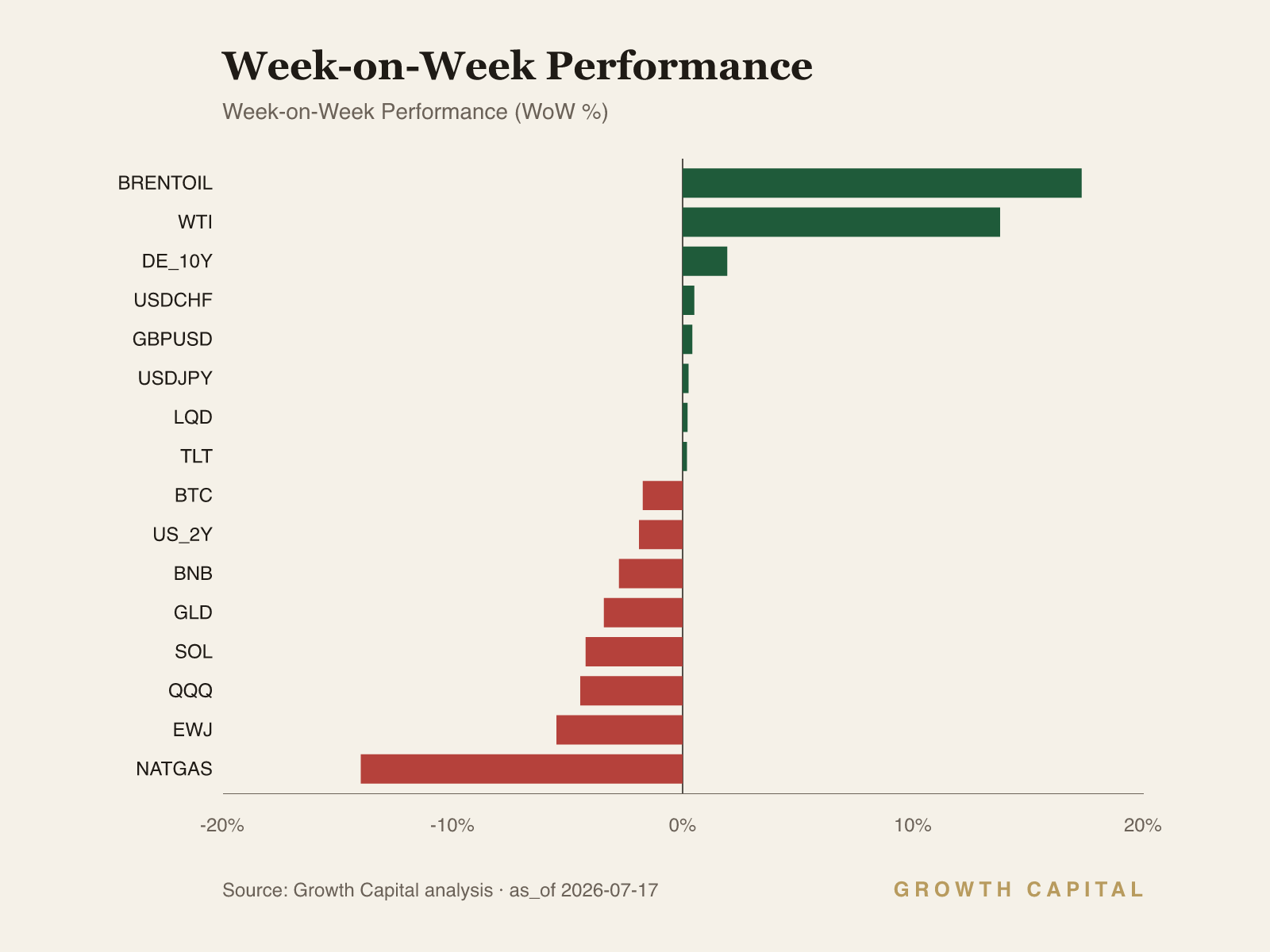
The hawkish hold hardened, not eased. The 2Y fell -1.9% WoW in yield to 4.13% while the 10Y held 4.55% against its 4.67% 52-week high, a 42bp gap that prices patience rather than cuts.
Equity weakness is a discount-rate event, not a credit event. QQQ fell -4.5% WoW against DIA's -1.1% while HYG added +0.1% WoW and sits just -1.1% YTD; credit's calm keeps us neutral, not underweight.
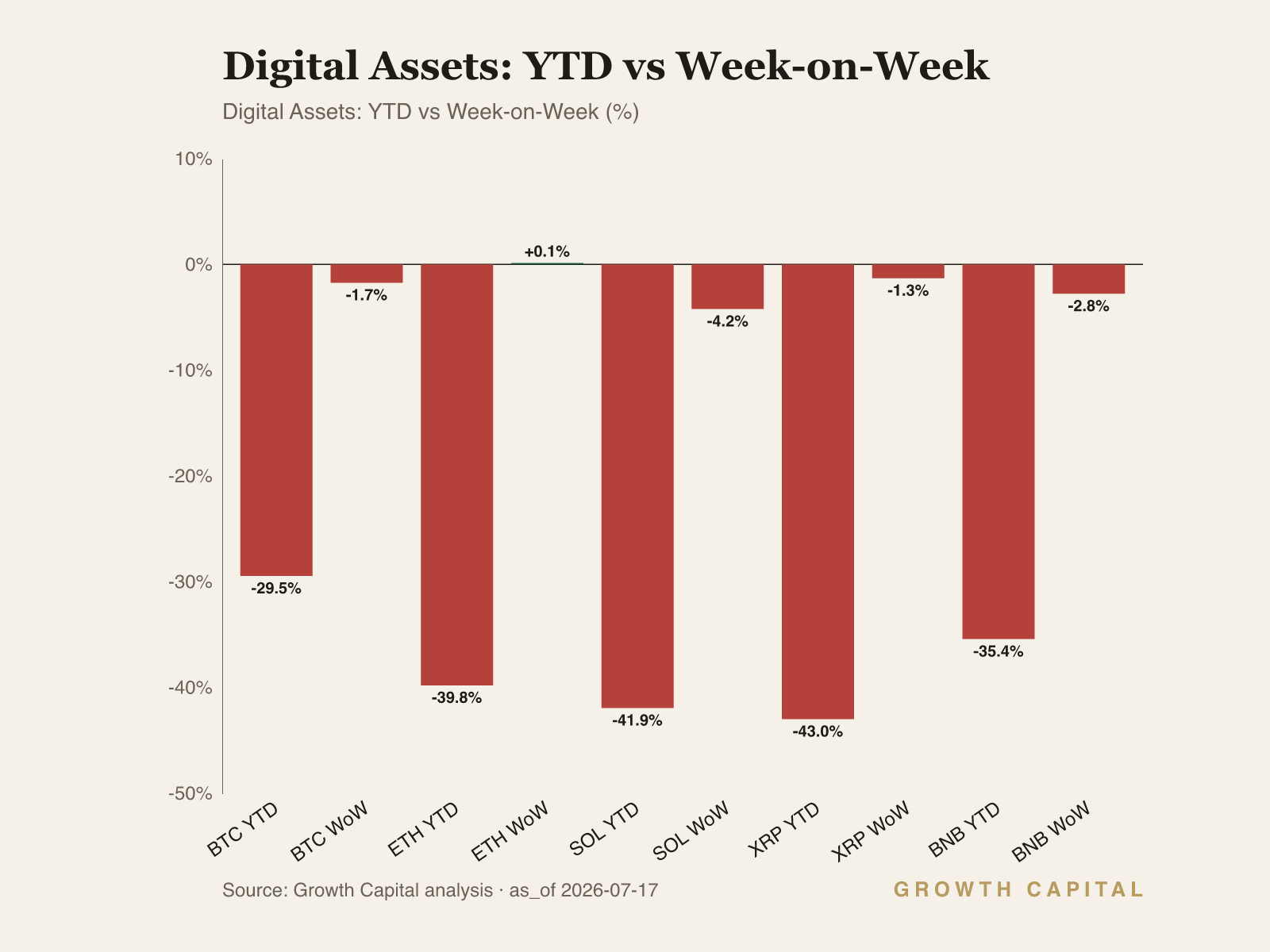
Crypto is still the furthest-duration risk on the tape. BTC at $62,647 is -29.5% YTD with total crypto market cap at $2.27T (-2.4% over 24 hours), and perp cohorts lean short across the majors; we stay underweight.
Our positioning: Front-end relief is not a pivot; we hold short-duration carry over long-bond and crypto beta while the Fed's hold hardens.
A hawkish hold with an energy complication
Our regime read for the week ending 17 July 2026 is a hawkish hold that is hardening, not easing. The effective federal funds rate sits at 3.63% while the US 2Y trades at 4.13%, and that 50bp gap is the most informative spread on the tape: the front end is still paying for residual tightening risk, not for cuts. Soft June goods-price data gave the front end a week of relief, with the 2Y easing -1.9% WoW in yield terms, yet the 10Y barely moved, holding 4.55% against its 4.67% 52-week high. Equity beta gave ground in sympathy, SPY -1.7% WoW and QQQ -4.5% WoW, while credit sat still with HYG +0.1% WoW. The message across assets is coherent: markets are repricing the duration of the hold, not the direction of policy. We treat the week's yield relief as noise inside a hold that a firmer energy complex and a dollar near its highs continue to harden. Our positioning follows directly: overweight front-end carry, underweight long duration, neutral equity beta, underweight crypto beta.
Start with the front end, because that is where the week's information lives. The 2Y closed at 4.13%, down -1.9% WoW in yield on the soft June prints, yet it remains +19.0% YTD and only 13bp beneath its 4.26% 52-week high, while the 10Y gave back just -0.2% WoW to 4.55%, leaving the 10Y at 4.55% versus the 2Y at 4.13%, a 42bp gap. TLT confirmed the stalemate with a +0.2% WoW gain that leaves it -2.8% YTD and slightly oversold, 1.9% above its 83.02 52-week low, and the German 10Y moved the other way entirely, +1.9% WoW to 3.15%, within 6bp of its 3.21% high. The transmission channel runs policy expectations to front-end yields to duration to equity multiples, and each link behaved this week. Soft goods prints compress the near-term inflation path, which pulls the 2Y lower; but the policy reaction function is anchored to services and energy pass-through, and with the 2Y at 4.13% still 50bp above the 3.63% effective funds rate, the market is paying for residual tightening risk rather than pricing easing. That keeps the discount rate on long-duration cash flows pinned, which is why the 10Y refused to follow the 2Y down and why the longest-duration equity proxy, QQQ at -4.5% WoW, absorbed the week's damage. We are overweight front-end carry and underweight long duration on a three-month horizon; at 4.13% the 2Y pays us to wait against a 4.2% unemployment rate and 2.1% annualized GDP growth, and the convexity we forgo is convexity this cycle does not yet require. The falsifier is explicit: a 10Y close above its 4.67% 52-week high would tell us term premium, not policy, is setting the long end, and we would extend the duration underweight; a 2Y through the 3.63% funds rate would mean the market is pricing cuts, and we would rotate front-end carry into intermediate duration.
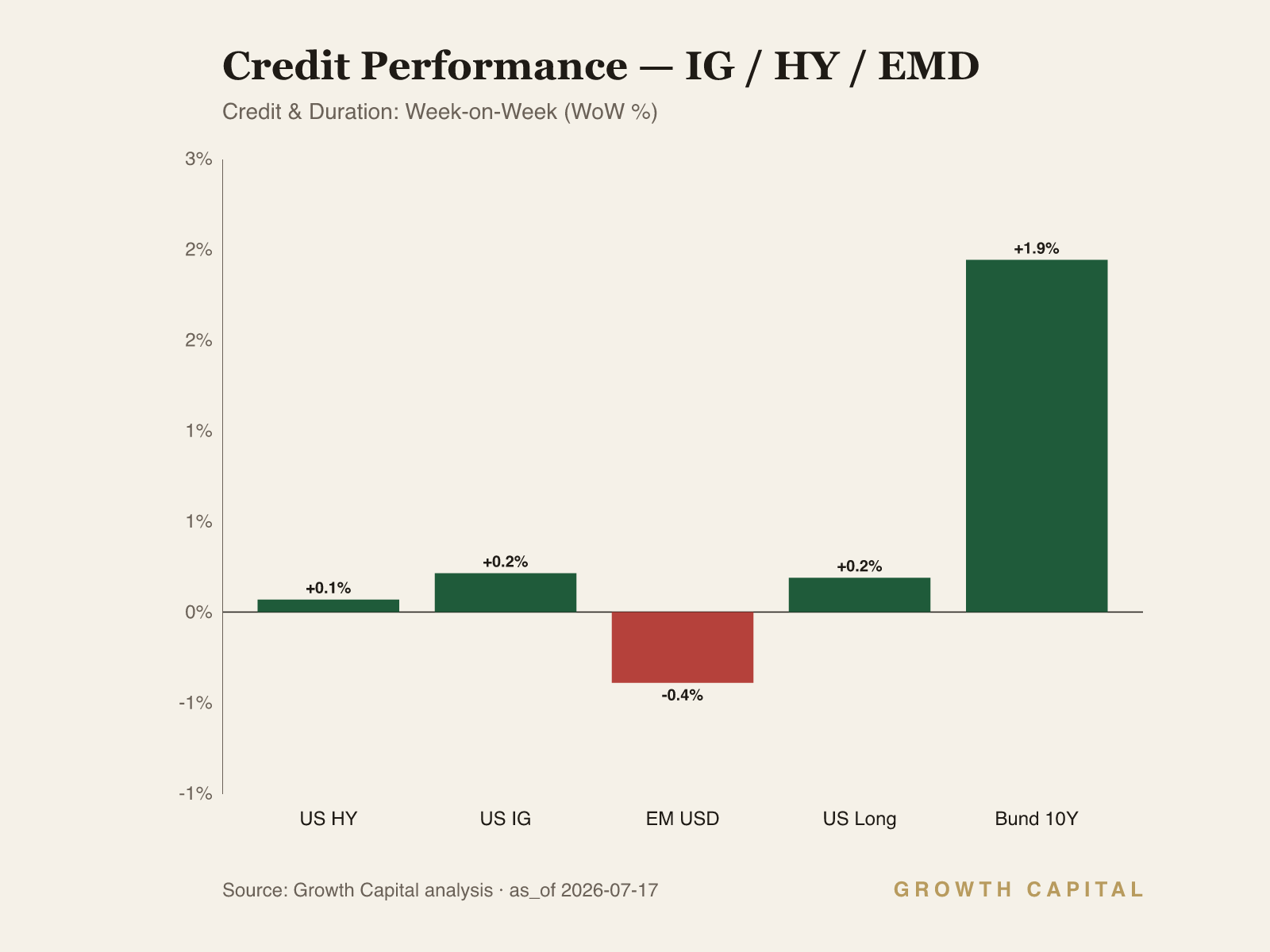
The equity and credit tape confirms the hawkish-hold read rather than contradicting it, and the confirmation sits in the cross-section. SPY fell -1.7% WoW to 742.30, still +8.7% YTD, but QQQ dropped -4.5% WoW against DIA's -1.1%, a 3.4pp single-week gap between the longest-duration and shortest-duration US proxies, and EWJ fell -5.5% WoW on the same semiconductor unwind. Credit did not move: HYG added +0.1% WoW and sits just -1.1% YTD at 79.76, only 1.3% above its 78.72 52-week low, while LQD gained +0.2% WoW and EMB slipped -0.4% WoW. That combination is the signature of a discount-rate event, not a growth event; if the chip-led selloff carried earnings information, the marginal borrower would reprice first and high yield would gap wider, and it has not. The unwind concentrates where multiple compression bites hardest, which is exactly what a 10Y pinned at 4.55% should produce. We stay neutral equity beta, preferring cash-flow-backed quality to long-duration growth, and we hold rather than chase IWM's +17.4% YTD. A HYG break below 78.72 is the tripwire that would tell us credit has joined the repricing, and we would cut equity from neutral to underweight.
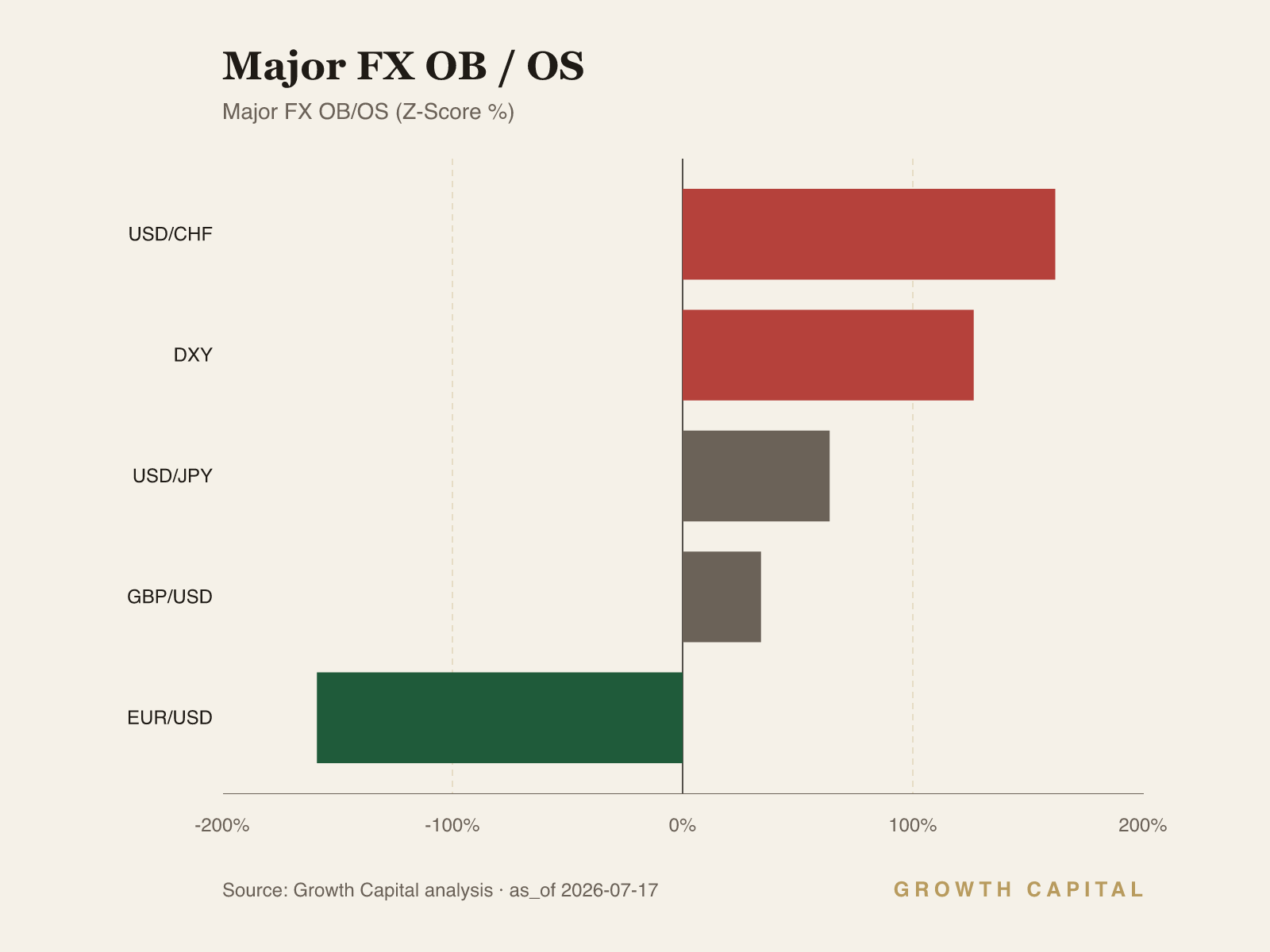
The dollar is the quiet confirmation of the regime read. DXY at 120.50 (-0.2% WoW, +0.8% YTD) is slightly overbought within 1.2% of its 121.92 52-week high, USD/JPY at 161.31 trades within 0.9% of its 162.67 high, and EUR/USD at 1.1438 holds less than 1% above its 1.1348 low even as the ECB tightens into the Fed's pause. The channel runs FX to import prices to CPI: a strong dollar combined with a repriced energy complex, Brent +17.3% WoW to $81.62 on our primary feed (a print we discount because our cross-check source diverges by more than 4% on the level), raises the imported-inflation bill outside the US and pushes foreign central banks toward tighter policy, which is what the Bund's +1.9% WoW move to 3.15% is registering. For risk assets the coherence is direct: dollar strength plus firm energy is the pass-through mix that hardens the Fed's hold and keeps global liquidity tight. We hold EUR/USD at neutral; the rate differential pulls one way, ECB tightening the other, and at 1.1438 neither side has won. A DXY push through 121.92 would extend the risk-off lean across the book.
Our falsifiers are specific. On the downside, a 10Y close above 4.67% combined with HYG breaking 78.72 would mark the shift from discount-rate repricing to credit stress; we would cut equity to underweight, extend the duration underweight, and expect BTC to test its 58,608 52-week low. On the upside, DXY below its 117.44 52-week low alongside an energy retracement would say the pass-through channel is fading faster than we expect; we would add intermediate duration, lift gold from underweight to neutral, and revisit equity beta. Between those markers, the 2Y against the 3.63% effective funds rate is the spread we watch daily. A 2Y below the funds rate is the market calling the peak; a 2Y through its 4.26% high is the market calling the Fed behind. Neither happened this week, which is why we call this a hold that is hardening rather than a regime in transition.
Source: GrowthCapital analysis; market data from exchange and FRED snapshots as of 17 July 2026; on-chain data from Nansen and Hyperliquid.
Fixed Income
Fixed income is where the week's thesis lives. The 2Y closed at 4.13%, easing -1.9% WoW in yield on soft June goods-price data but still +19.0% YTD and only 13bp beneath its 4.26% 52-week high; the 10Y gave back just -0.2% WoW to 4.55%, leaving the 10Y at 4.55% versus the 2Y at 4.13%, a 42bp gap. TLT confirmed the stalemate, up +0.2% WoW yet -2.8% YTD and slightly oversold, 1.9% above its 83.02 52-week low, while LQD added +0.2% WoW to 107.69, itself slightly oversold at -2.2% YTD. The mechanism is a tug-of-war between the data and the reaction function: soft goods prints compress the near-term inflation path and pull the 2Y down, but with the 2Y still 50bp above the 3.63% effective funds rate, the market continues to price residual tightening risk, and the long end refuses to rally because energy repricing threatens breakevens and term premium. Credit is the quiet corroboration: HYG at 79.76 sits just 1.3% above its 78.72 low with a -1.1% YTD drawdown, no stress, which tells us the repricing is about discount rates, not default risk. We are overweight the front end for its carry, underweight TLT-style long duration, and neutral LQD, where spread income offsets duration drag. Falsifiers: a 10Y close above 4.67% extends the duration underweight; a 2Y through the 3.63% funds rate rotates our front-end overweight into intermediate duration.
Equities
The equity tape confirms the discount-rate read, and the confirmation is in the cross-section rather than the index level. SPY fell -1.7% WoW to 742.30, still +8.7% YTD and slightly overbought, while QQQ dropped -4.5% WoW against DIA's -1.1%, a 3.4pp gap between the longest-duration and shortest-duration US proxies in a single week. The unwind was chip-led and global: EWJ fell -5.5% WoW, the worst of our DM proxies, as the semiconductor complex re-rated on doubt that AI capex converts to cash flow on the schedule the multiples assume. The mechanism runs rates to duration to multiples: with the 10Y pinned at 4.55%, 12bp under its 4.67% 52-week high, the present value of distant cash flows cannot re-rate higher, so compression lands exactly where duration is longest, which is why QQQ's +13.1% YTD leadership bore the damage while DIA at +7.5% YTD barely moved. IWM is the complication: +17.4% YTD leads every US proxy, but small-cap leadership built on rate-cut hope is fragile when the 2Y at 4.13% still trades 50bp above the 3.63% funds rate. We are neutral SPY, QQQ, IWM and EWJ on a three-month horizon, and we prefer cash-flow-backed quality within the allocation, accepting forgone upside in a chip-led rebound. Our triggers: SPY through its 759.57 52-week high on improving breadth moves us to overweight; a QQQ decline of more than 10% from its 746.16 high with HYG breaking 78.72 cuts the class to underweight.
Digital Assets
Digital assets remain the furthest-duration risk on the tape, and the week treated them accordingly. BTC closed at $62,647, -1.7% WoW and -29.5% YTD, trading 6.9% above its 58,608 52-week low; ETH held $1,808.64, +0.1% WoW but -39.8% YTD; SOL fell -4.2% WoW to $73.65, -41.9% YTD. Total crypto market cap sits at $2.27T, down -2.4% over 24 hours on $252.8B of daily volume, and BTC dominance at 55.5% keeps grinding higher, the standard signature of risk aversion inside the asset class as capital retreats up the quality curve. The mechanism is the same discount-rate channel pressing long-duration equity: with the effective funds rate at 3.63% and the 10Y at 4.55%, there is no liquidity impulse to fund the marginal crypto bid, and assets priced off distant adoption cash flows re-rate hardest when the hold extends. Derivatives cohorts on Hyperliquid lean net short across the majors while funding stays positive, meaning longs pay to hold losing positions (detail in On-Chain Pulse). We are underweight BTC, ETH and SOL on a three-month horizon, and we accept the risk of a violent short-cover rally as the cost of respecting the tape. Our change-of-view triggers are specific: BTC holding its 58,608 low while cohort shorts cover would start the upgrade clock, and ETH is first in line given its spot-withdrawal accumulation signature. A 2Y falling through the 3.63% funds rate, the market pricing cuts, would be the macro release valve that changes the class-level call.
Commodities
Gold is the week's cleanest demonstration that rates now set the price of everything with duration, including the oldest hedge. GLD fell -3.4% WoW to 364.11, is -8.6% YTD, in a downtrend and slightly oversold, 26.6% below its 495.90 52-week high yet still 21.0% above its 300.96 low. The mechanism is the real-rate channel: gold pays no coupon, so its opportunity cost is the yield on paper, and with the 10Y at 4.55% and the effective funds rate at 3.63%, the carrying cost of a zero-yield hedge sits at cycle highs. A geopolitical backdrop this tense that still cannot overcome that arithmetic tells us the marginal buyer of gold is a rates trader, not a safe-haven seeker. The dollar compounds the pressure: DXY at 120.50, within 1.2% of its 121.92 52-week high, lifts gold's price in every non-dollar currency at once. Elsewhere in the complex, natural gas fell -14.0% WoW to $2.83/MMBtu, roughly flat YTD at +0.4%, though our cross-check source prints the level about 1.2% higher, so we treat the figure as indicative rather than precise; injection-season storage builds cap rallies from here. The broader energy complex repriced sharply higher on supply risk, and that firmness feeds the inflation channel that keeps gold's real-rate problem alive. We are underweight GLD on a three-month horizon. A DXY break below its 117.44 52-week low, or a 10Y retreat from 4.55% toward its 3.97% 52-week low, would move us back to neutral.
GC Views
| Asset | View | Rationale |
|---|---|---|
| US_10Y | N | 4.55% sits 12bp under the 4.67% 52w high; pinned by term-premium and energy pass-through risk, not yet a break |
| US_2Y | OW | 4.13% carries 50bp over the 3.63% funds rate and sits 13bp under the 4.26% high; paid to wait out the hold |
| TLT | UW | -2.8% YTD and just 1.9% above the 83.02 52w low; no duration case while the hold hardens |
| LQD | N | +0.2% WoW to 107.69, slightly oversold; spread carry acceptable but duration drag caps upside |
| HYG | N | 79.76 is 1.3% above the 78.72 52w low at -1.1% YTD; calm credit is our no-recession tell |
| SPY | N | -1.7% WoW to 742.30 after +8.7% YTD; multiples capped with the 10Y at 4.55% |
| QQQ | N | -4.5% WoW chip-led unwind; +13.1% YTD leadership narrows, we hold rather than add |
| DIA | N | -1.1% WoW, +7.5% YTD; shortest-duration US proxy holds best in a discount-rate event |
| IWM | N | +17.4% YTD leads US proxies, but rate-cut leverage cuts both ways with the 2Y at 4.13% |
| BTC | UW | -29.5% YTD with perp cohorts net short; the 58,608 52w low is the level that must hold |
| GLD | UW | -8.6% YTD; trading as a rates asset with the 10Y at 4.55%, oversold at 364.11 is not yet a floor |
| EURUSD | N | 1.1438 within 1% of the 1.1348 52w low; ECB tightening offsets the dollar's carry pull |
On-Chain Pulse
The cross-asset on-chain pattern this week is cautious positioning with a bearish derivatives bias. Smart money on Hyperliquid perps is net short all five majors we track, while spot exchange flows diverge sharply: ETH sees heavy withdrawals, an accumulation signature, while SOL faces substantial exchange inflows, a distribution signature. The perp tape and the spot tape are not telling the same story, and that divergence is the week's signal.
Bitcoin carries the richest data and the clearest tension. Over the Nansen 7-day window the price fell -2.4%, from $64,155 to $62,620, consistent with the -1.7% WoW in our snapshot close of $62,647. On Hyperliquid, smart traders are net short $41.5M ($45.8M of longs against $87.3M of shorts on $133.1M of total exposure), whales are net short $32.5M on a $2.2B book split $1.1B a side, roughly 16x the smart-trader exposure, and public figures are net short $19.7M. The spot side disagrees: top-PnL wallets registered a +$29M net inflow at 1.7x their average activity across 34 accumulating wallets, while net flow to exchanges was a mild +$2M at half the average pace, hardly forced selling. Derivatives statistics sharpen the tension: open interest stands at $2.5B across 49,909 traders, 7-day perp volume ran $12.8B with a +$135M net buy flow, and funding prints +10.95% annualized, meaning longs are paying shorts to hold a losing position. Our positioning implication is unchanged: underweight, fade strength while every tracked cohort is net short and funding stays positive, and treat the 58,608 52-week low from our snapshot as the level that must hold for the accumulation case to survive.
Ethereum shows the strongest spot-versus-perps divergence of the majors. Nansen flags heavy net withdrawal from exchanges over the window, the classic accumulation signature, and the spot price held +0.1% WoW at $1,808.64 despite a -39.8% YTD drawdown. Against that, Hyperliquid smart money is net short ETH alongside the other majors; the intel window carries the directional cohort lean but not the dollar sizing it provides for BTC, so we weight the signal accordingly and do not attach a size we cannot verify. The tension resolves one of two ways: either shorts cover into a thinning spot float, or the withdrawal bid exhausts and price follows the perp book lower. We stay underweight but rank ETH the first major we would upgrade; a funding flip alongside continued exchange withdrawals is the trigger we want to see.
Solana is the cleanest bearish alignment on the board. Exchange flows show substantial net inflows, a distribution signature, and Hyperliquid smart money is net short here as well, so the spot and perp tapes point the same direction for once. Price action agrees: SOL fell -4.2% WoW to $73.65 and is -41.9% YTD, the deepest drawdown among the majors we track, though it still trades 18.5% above its 62.15 52-week low. When distribution on the spot side meets a short-leaning derivatives book, we do not fight the alignment. SOL is our highest-conviction underweight in digital assets; a durable reversal of exchange inflows is the minimum precondition for revisiting that stance.
What We're Watching
Four markers govern our stance. If the 10Y closes above its 4.67% 52-week high, we extend the long-duration underweight and cut equity beta toward underweight. If HYG breaks its 78.72 52-week low, the discount-rate event has become a credit event and we de-risk across the book. If the 2Y trades below the 3.63% effective funds rate, the market is pricing cuts and we rotate front-end carry into intermediate duration. On the upside, DXY below its 117.44 52-week low with energy retracing would ease the pass-through channel; we would lift gold from underweight to neutral and revisit crypto beta, where BTC's 58,608 52-week low is the level that must hold for any upgrade case.
This Week in Charts